
If you want to build bigger and stronger arms, the dips workout for triceps is one of the most powerful exercises you can add to your training routine. This simple yet effective movement has been helping fitness lovers and athletes develop impressive arm muscles for decades. Whether you are working out at home or in the gym, dips can help you reach your arm training goals faster than you might think.
The beauty of dips for triceps is that you do not need fancy equipment or expensive machines to get started. A simple chair, bench, or parallel bars can give you everything you need to work your triceps effectively. Many fitness experts consider this exercise as one of the best movements for building the back of your arms because it uses your own body weight to create resistance.
In this complete guide, you will learn everything about dips workout for triceps including the proper technique, different variations, common mistakes to avoid, and how to progress safely. By the end of this article, you will have all the knowledge you need to start building stronger and more defined triceps today.
What is Dips Workout for Triceps?
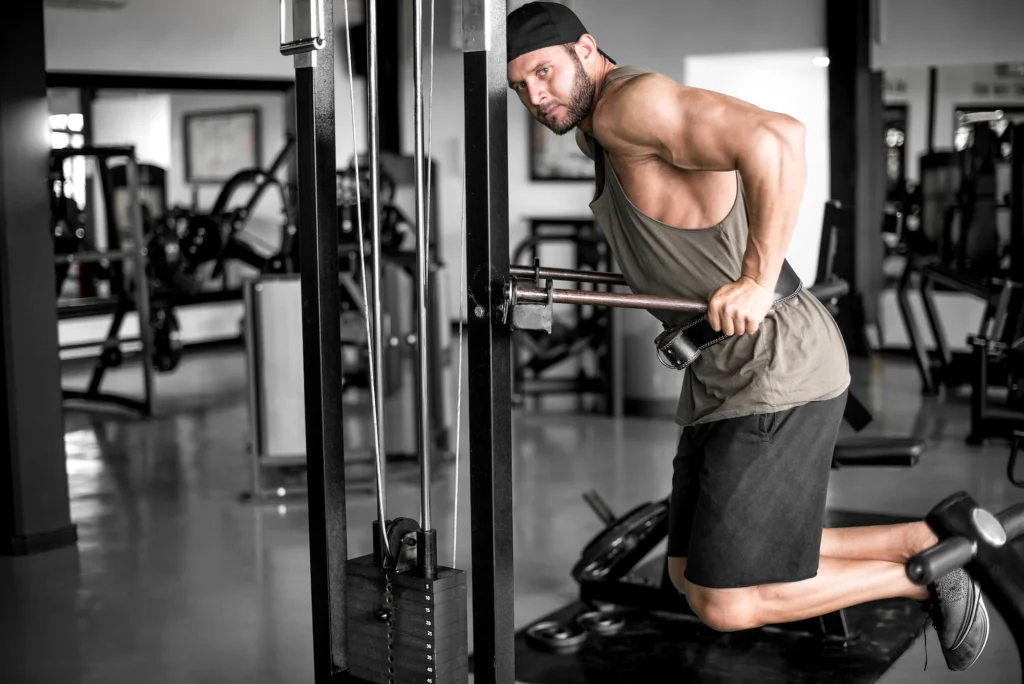
Dips workout for triceps is a bodyweight exercise where you lower and raise your body using your arms. The main focus is on the triceps muscles which are located on the back of your upper arms. During this exercise, you support your body weight with your hands while bending and straightening your elbows to move your body up and down.
This exercise can be done in different ways depending on what equipment you have available. You can perform bench dips using a chair or bench, or you can do parallel bar dips using special dip bars at the gym. Both versions work your triceps effectively, but they challenge your muscles in slightly different ways.
What makes dips special is that they are a compound exercise. This means they work multiple muscle groups at the same time. While your triceps do most of the work, your chest muscles, shoulders, and core also help during the movement. This makes dips a very efficient exercise for building overall upper body strength.
Why Dips are the Best Exercise for Triceps
Your triceps make up about 60 percent of your upper arm mass. This is a huge portion of your arm, which is why focusing on tricep exercises like dips is so important for building bigger arms. Many people spend too much time working on their biceps and forget about the triceps, but the truth is that strong triceps give your arms the impressive size and shape you are looking for.
The dips workout for triceps is considered one of the most effective arm exercises because it allows you to move through a full range of motion. When you lower your body during a dip, your triceps get a deep stretch at the bottom position. Then when you push yourself back up, your triceps contract powerfully to lift your entire body weight. This combination of stretch and contraction helps build both muscle size and strength.
Another reason why dips are so effective is that they can be done anywhere. You do not need to wait for equipment at the gym or spend money on expensive machines. A sturdy chair at home, a park bench outside, or even the edge of a coffee table can work perfectly for doing dips. This makes it easy to stay consistent with your tricep training no matter where you are.
Research and fitness professionals have shown that dips create more muscle activation in the triceps compared to many other arm exercises. This is because your body weight provides natural resistance that increases as you get stronger. As you build muscle and gain weight, the exercise automatically becomes more challenging, which helps you continue making progress over time.
Muscles Worked During Dips Workout
While dips are famous for working the triceps, they actually target several important muscle groups in your upper body. Understanding which muscles are involved can help you perform the exercise better and appreciate all the benefits it provides.
The triceps are the primary muscles that work during dips. These muscles have three different parts called heads – the long head, lateral head, and medial head. All three parts work together to straighten your elbow joint as you push yourself up from the bottom position. The more upright you keep your body during dips, the more your triceps have to work compared to other muscles.
Your shoulder muscles, also called deltoids, play an important supporting role during dips. They help keep your shoulder joints stable as you move up and down. The front part of your shoulder works especially hard to control the movement and prevent your body from swinging.
Your chest muscles, known as the pectorals, also get involved during dips workout for triceps. When you lean forward slightly during the movement, your chest muscles help push your body back up. However, if you keep your body more upright and your elbows close to your sides, you can reduce chest involvement and focus more on your triceps.
Your core muscles work throughout the entire exercise to keep your body stable and prevent you from swinging. This includes your abs and lower back muscles. Even though you might not feel them burning, they are working hard to maintain proper body position during each repetition.
How to Do Dips for Triceps Properly
Learning the correct technique for dips workout for triceps is very important for getting good results and staying safe. Poor form can lead to shoulder pain or injuries, so take time to master the basics before trying to do too many repetitions or adding extra weight.
Bench Dips Technique
Bench dips are perfect for beginners who are just starting with tricep training. Find a stable bench, chair, or any elevated surface that is about knee height. Sit on the edge of the surface and place your hands next to your hips with your fingers pointing forward. Your palms should grip the edge firmly.
Slide your body forward off the bench so your weight is supported by your arms. Extend your legs out in front of you with your heels on the ground. If you are new to exercise, you can bend your knees at 90 degrees to make the movement easier. For more challenge, straighten your legs completely.
Keep your back close to the bench and slowly lower your body by bending your elbows. Your elbows should point straight back, not out to the sides. Lower yourself until your elbows reach about 90 degrees or until you feel a good stretch in your triceps. Do not go too low as this can put too much stress on your shoulders.
Push through your palms to straighten your arms and return to the starting position. Focus on using your triceps to lift your body, not momentum. Keep the movement slow and controlled throughout. Aim to complete 10 to 15 repetitions for 2 to 3 sets when you are starting out.
Parallel Bar Dips Technique
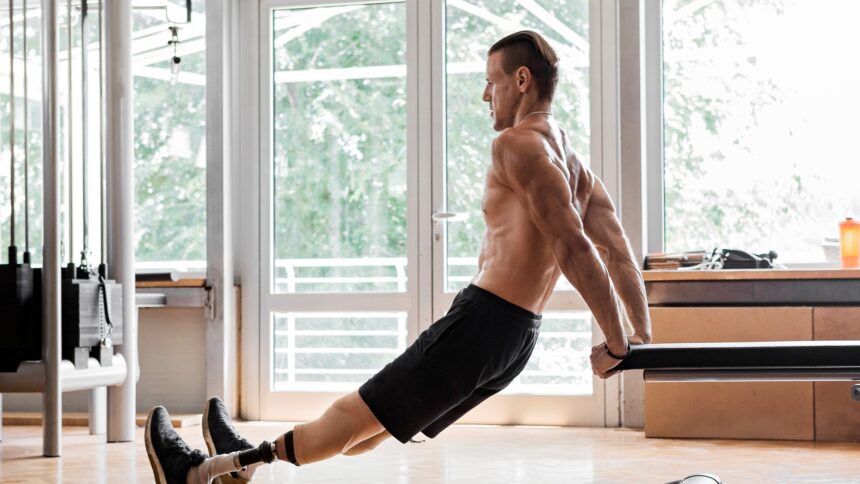
Parallel bar dips are more advanced and require good upper body strength. Stand between a set of parallel bars or dip station at your gym. Grab each bar with your palms facing inward and jump up to support your body weight with straight arms. Your wrists, elbows, and shoulders should stack in a straight line.
Keep your body as upright as possible – this is the key to making your triceps work harder instead of your chest. Pull your shoulders back and down, away from your ears. You can cross your ankles behind you or let your legs hang straight down.
Slowly bend your elbows to lower your body down. Keep your elbows pointing back and tucked close to your sides throughout the movement. Lower yourself until your elbows are at about shoulder height or slightly below. Do not go too deep if you feel any pain in your shoulders.
Push yourself back up by straightening your arms, focusing on squeezing your triceps at the top. Do not lock out your elbows completely at the top as this can take tension off your muscles. Keep a slight bend in your elbows to maintain constant tension on your triceps.
For parallel bar dips, aim for 3 to 5 sets of 5 to 10 repetitions. Quality is more important than quantity, so focus on performing each repetition with perfect form rather than rushing through many sloppy reps.
Common Mistakes to Avoid
Many people make mistakes when doing dips workout for triceps that reduce the effectiveness of the exercise or increase injury risk. Being aware of these common errors can help you get better results and stay safe during your training.
One of the biggest mistakes is lowering your body too far down. While going through a full range of motion is generally good, dropping too low during dips can put dangerous stress on your shoulder joints. Stop lowering when your elbows reach about 90 degrees or when your shoulders drop below your elbows. If you feel any pinching or pain in your shoulders, you are going too deep.
Another common error is letting your elbows flare out to the sides instead of keeping them tucked back. When your elbows point outward, you shift more work to your chest and shoulders instead of your triceps. Keep your elbows pointing straight back and close to your body throughout the entire movement.
Many people bounce at the bottom of the movement to help push themselves back up. This bouncing uses momentum instead of muscle strength and can hurt your shoulders. Always perform dips in a slow and controlled manner. Pause briefly at the bottom position before pushing back up using only your muscle power.
Shrugging your shoulders up toward your ears is another mistake that reduces the effectiveness of dips. Your shoulders should stay pulled back and down throughout the exercise. Think about squeezing your shoulder blades together slightly to maintain good shoulder position.
Rushing through repetitions without focusing on proper form is a mistake that prevents muscle growth. Each repetition should take at least 2 to 3 seconds to lower down and 1 to 2 seconds to push back up. This slow tempo keeps your muscles under tension longer, which helps them grow stronger.
Different Variations of Dips for Triceps
Once you master the basic dips workout for triceps, you can try different variations to keep challenging your muscles and prevent your workouts from becoming boring. Each variation offers unique benefits and can help you break through training plateaus.
Floor dips are the easiest variation and perfect for complete beginners. Sit on the floor with your knees bent and feet flat on the ground. Place your hands on the floor beside your hips with fingers pointing forward. Push through your hands to lift your hips off the floor, then lower them back down. This variation is great for learning the movement pattern with minimal stress on your shoulders.
Band-assisted dips help you build strength if regular bodyweight dips are too difficult. Loop a resistance band around the dip bars and place your knees or feet on the band. The band supports some of your body weight, making it easier to perform the movement. As you get stronger, you can use lighter bands or remove the assistance completely.
Weighted dips are for advanced exercisers who can easily perform 15 or more bodyweight dips. Attach a weight plate to a dipping belt around your waist or hold a dumbbell between your feet. Start with just 5 to 10 pounds of extra weight and gradually increase as you get stronger. Weighted dips help you continue building muscle size and strength even after you have mastered bodyweight variations.
Elevated feet dips increase the difficulty of bench dips by placing your feet on another bench or elevated surface. This puts more of your body weight on your arms, making your triceps work harder. This variation bridges the gap between bench dips and parallel bar dips in terms of difficulty.
How to Progress with Dips Workout
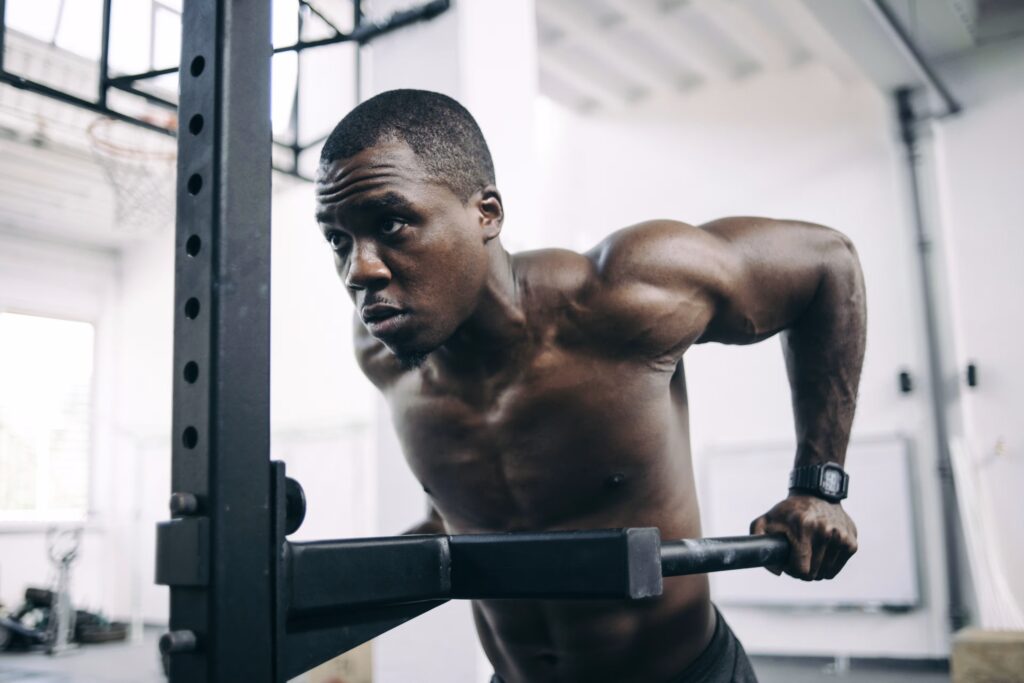
Building strength with dips workout for triceps takes time and patience. Following a smart progression plan helps you improve safely without getting injured or burning out. The key is to make small improvements each week rather than trying to do too much too soon.
If you cannot do a single bodyweight dip yet, start with easier exercises like floor dips or wall push-ups. Practice these movements 2 to 3 times per week, doing 2 to 3 sets of as many repetitions as you can with good form. Focus on gradually increasing your repetitions each week.
After a few weeks of easier variations, try bench dips with bent knees. Once you can comfortably perform 15 repetitions with bent knees, straighten your legs to make the exercise harder. When you can do 15 repetitions with straight legs, you are ready to try parallel bar dips with assistance.
When starting parallel bar dips, use band assistance or have a training partner support your feet. Practice the full range of motion even with assistance. As the weeks go by, gradually reduce the assistance until you can perform dips with your full body weight.
Once you can complete 12 to 15 clean bodyweight dips on parallel bars, you can start adding weight. Begin with just 5 pounds attached to a dipping belt. Add 2.5 to 5 pounds every 1 to 2 weeks as long as you can maintain perfect form. This slow and steady approach helps you build strength safely over time.
Remember to listen to your body throughout your progression. If your shoulders or elbows hurt during or after dips, take a few days off to recover. Pain is different from muscle soreness – pain is a signal that something might be wrong. Never push through joint pain when doing strength exercises.
Ready to take your arm training to the next level? Visit Men’s Buddy for more expert fitness guides, workout plans, and nutrition tips that will help you build the strong and muscular body you have always wanted. Our complete resource library has everything you need to reach your fitness goals faster.
Frequently Asked Questions
How many dips should I do for triceps?
For beginners, aim to complete 2 to 3 sets of 8 to 12 repetitions of bench dips. More advanced exercisers doing parallel bar dips should target 3 to 5 sets of 5 to 10 repetitions. The exact number depends on your current strength level and fitness goals. Quality always matters more than quantity, so focus on performing each repetition with perfect form rather than trying to do as many as possible with poor technique.
Are dips better than push-ups for triceps?
Both dips and push-ups are excellent exercises for triceps, but dips typically provide more tricep activation because they allow for a greater range of motion and put more direct load on the muscles. Dips also use your full body weight as resistance, while regular push-ups support some of your weight on your feet. However, the best exercise is the one you can perform with proper form, so include both movements in your training for complete tricep development.
Can I do dips workout for triceps every day?
You should not do dips every single day because your muscles need time to recover and grow stronger. Your triceps need at least 24 to 48 hours of rest between training sessions. Doing dips 2 to 3 times per week with rest days in between is ideal for most people. This schedule gives your muscles enough time to repair and become stronger while preventing overtraining and injuries.
Why do my shoulders hurt when doing dips?
Shoulder pain during dips usually happens because you are going too low, your shoulders are rolling forward, or you have existing shoulder flexibility problems. To fix this, do not lower yourself past the point where your elbows reach 90 degrees. Keep your shoulders pulled back and down throughout the movement. If pain continues, stop doing dips and talk to a doctor or physical therapist. You may need to improve your shoulder flexibility before continuing with dips.
How long does it take to see results from dips?
Most people start noticing increased arm strength within 2 to 3 weeks of consistent dip training. Visible muscle growth usually takes 6 to 8 weeks of regular training combined with proper nutrition. Remember that everyone progresses at different speeds based on their starting point, genetics, diet, and training consistency. Stay patient and focus on making small improvements each week rather than expecting dramatic overnight changes.
Can beginners do dips for triceps?
Yes, beginners can absolutely do dips workout for triceps by starting with easier variations like floor dips or bench dips with bent knees. These modified versions reduce the amount of body weight you need to lift, making them perfect for building initial strength. As you get stronger over several weeks, you can progress to more challenging variations. The key is starting at a level that matches your current fitness and gradually working your way up.
Conclusion
The dips workout for triceps is one of the most effective exercises you can do to build bigger, stronger arms. This simple bodyweight movement works your triceps intensely while also strengthening your shoulders, chest, and core. Whether you are a complete beginner or an experienced athlete, there is a dip variation that fits your current strength level.
Starting with bench dips and progressing to parallel bar dips gives you a clear path to follow as you get stronger. Remember to focus on proper form, avoid common mistakes, and give your muscles enough rest between training sessions. With consistent effort over several weeks and months, you will see impressive improvements in both the size and strength of your arms.
The best part about dips is that you can do them almost anywhere with minimal equipment. This makes it easy to stay consistent with your training whether you are at home, traveling, or working out at the gym. Start adding dips to your arm workouts today and experience the powerful results this classic exercise can deliver.
For more comprehensive fitness guides and workout programs designed specifically for men, explore the resources available at Men’s Buddy. Building your best body starts with having the right information and taking action on what you learn.