

A patchy beard is one of the most frustrating grooming challenges a man can face. You want a full, thick beard — but certain areas simply refuse to cooperate. Before you give up and reach for the razor, understand this: almost every man has some degree of patchiness in their beard, and many of the most impressively full beards you see today started as patchy, uneven growth patterns.
The difference between men who end up with great beards and those who do not comes down to patience and the right strategy. In this guide, we cover 12 proven beard growth tips for patchy beards — from targeted lifestyle changes to grooming techniques that create the appearance of fullness even while you are still growing.
📊 Beardbrand Global Survey (2025): 68% of men who successfully grew a full, thick beard reported starting with a patchy, uneven growth pattern. Patience and consistency are the two primary determinants of outcome.
Why Is My Beard Patchy? The Root Causes Explained
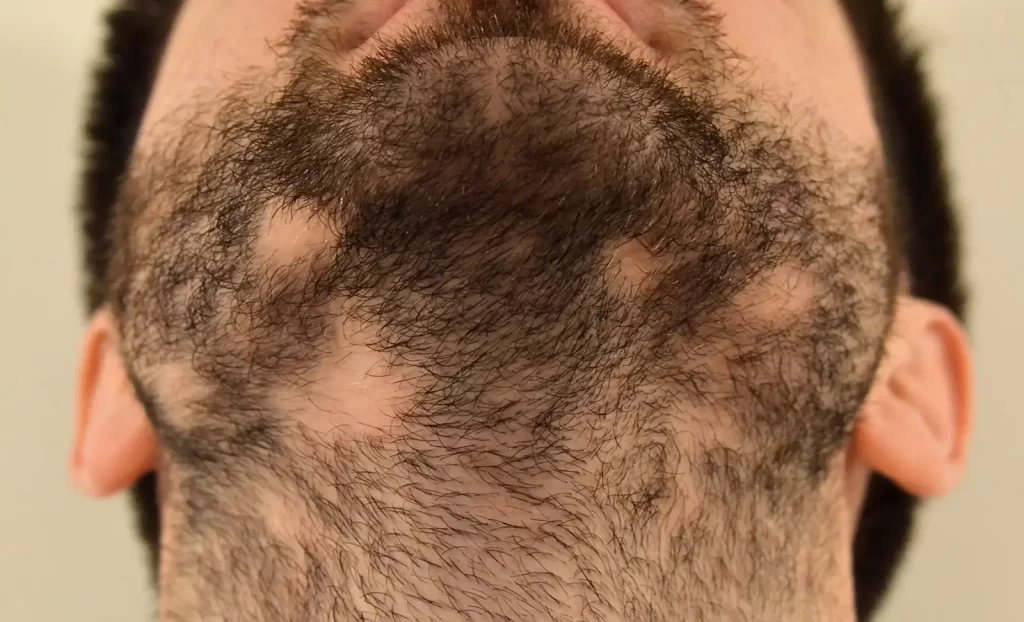
- Genetics: The most common cause of patchy beards. If your father or grandfather had thin or uneven beards, yours may be naturally lower in follicle density in certain areas. Genetics determines both follicle density and the sensitivity of follicles to DHT — the hormone that drives beard development.
- Low Testosterone or DHT: Both hormones are critical for beard follicle activation and growth speed. Chronically low levels result in slower and patchier beard development across the face.
- Nutritional deficiencies: Deficiencies in biotin, zinc, vitamin D, and vitamin B12 can significantly impair hair follicle function and slow growth across the entire beard area.
- Chronic stress and poor sleep: Both elevate cortisol, which directly suppresses DHT and disrupts the hair growth cycle by pushing follicles into the resting phase prematurely.
- Alopecia areata: An autoimmune condition causing characteristic circular bald patches on the beard. This is distinct from general patchiness and typically requires medical treatment.
12 Proven Beard Growth Tips for a Patchy Beard
Tip 1: Commit to a Minimum 90-Day Growth Period
This is the single most important tip in the entire guide. Most men shave or trim their patchy beard within 2 to 4 weeks — long before it has had any chance to fill in meaningfully. Beard hair grows at approximately 0.3 to 0.5mm per day. At 90 days, you have accumulated 2.7 to 4.5cm of growth — which is precisely when most patches begin to be covered by surrounding hairs growing at different angles and directions.
Commit to a minimum of 90 days of zero trimming before you make any final assessment of your beard’s full potential. This single decision has produced more beard success stories than any product or supplement on the market combined.
Tip 2: Naturally Optimise Your Testosterone and DHT
Testosterone converts to DHT via the enzyme 5-alpha-reductase within the skin and hair follicles. DHT is the primary hormonal driver responsible for activating beard follicles and determining growth speed. Men with higher DHT levels consistently grow fuller, denser beards. Natural strategies to boost DHT include: heavy resistance training 4 times per week, eating adequate healthy fats and dietary cholesterol, prioritising 7 to 9 hours of quality sleep nightly, and reducing body fat to a healthy range.
Tip 3: Use Minoxidil — The Evidence-Based Solution for Patchy Beards
Minoxidil — primarily known as the scalp hair loss treatment Rogaine — has been increasingly studied specifically for beard growth. A foundational Thai study replicated and expanded through 2024 found that 3% topical minoxidil applied to the beard area twice daily for 16 weeks produced significantly greater beard density compared to placebo — with results that persisted and improved with continued use.
Minoxidil works by prolonging the anagen (active growth) phase of hair follicles, effectively waking up dormant follicles in patchy areas. Use a 3% solution formulated for facial use, not the 5% scalp formula. Apply with a clean dropper, allow to absorb fully, and wash hands thoroughly afterward.
💡 PRO TIP: Minoxidil for beard growth is technically an off-label use. Consult a dermatologist before beginning, particularly if you have sensitive skin. Most side effects are mild and localised. It takes 4 to 6 months of consistent use to see meaningful results — patience is absolutely essential.
Tip 4: Apply Beard Oil Daily Without Exception
Beard oil moisturises the skin beneath your beard, reducing itchiness, flakiness (beard dandruff), and the inflammation that can impede follicle function and slow growth. It also conditions existing beard hairs, making them less prone to breakage and visually thicker and fuller. Look specifically for beard oils containing argan oil for conditioning, jojoba oil for skin compatibility, and castor oil — which is rich in ricinoleic acid and has evidence suggesting it may improve blood circulation to hair follicles.
Tip 5: Eat a Beard-Boosting Diet Consistently
Hair follicles are among the most metabolically active cells in the human body. They require a steady and consistent supply of specific nutrients to function at full capacity:
- Biotin (Vitamin B7): Found in eggs, nuts, and sweet potatoes. Supports keratin production — the structural protein that makes up beard hair.
- Zinc: Found in oysters, lean beef, and pumpkin seeds. Critical for both hair follicle function and DHT production.
- Vitamin D: Found in fatty fish, egg yolks, and through sunlight exposure. Deficiency is independently linked to patchy hair growth and alopecia.
- Protein: Beard hair is made of keratin — a protein. Aim for a minimum of 1.6g of protein per kg bodyweight daily.
- Iron: Iron deficiency causes diffuse hair shedding across the entire body. Found in red meat, spinach, and lentils.
Tip 6: Use a Derma Roller (Microneedling) for the Beard
A derma roller is a small handheld device covered in micro-needles that creates controlled micro-punctures in the skin when rolled over the beard area. This controlled micro-trauma stimulates collagen production, significantly increases blood flow to hair follicles, and is believed to improve minoxidil absorption by up to 4 times when both are used together as part of a protocol.
Use a 0.5 to 0.75mm needle length roller on the beard area twice per week on non-consecutive days.
💡 PRO TIP: Always use a fully clean, sterile derma roller on completely clean skin. Never apply minoxidil or any other active topical immediately after microneedling — wait at least 24 hours. The micro-channels created by the roller significantly increase absorption of anything applied to the skin, which can cause adverse reactions if active products are applied too soon.
Tip 7: Prioritise Sleep Quality and Duration
Human growth hormone — which directly supports hair follicle activity and cell renewal — is primarily released during deep sleep stages 3 and 4. Men who consistently sleep fewer than 7 hours per night have measurably lower growth hormone and DHT levels compared to those who sleep 7 to 9 hours. Prioritise both the duration and quality of your sleep, and observe the difference in beard growth speed and density over 4 to 6 weeks of consistency.
Tip 8: Exercise Regularly — Specifically Resistance Training
Regular resistance training raises both testosterone and DHT, improves blood circulation to the skin and hair follicles, and reduces the stress hormones that suppress hair growth. High-intensity exercise also stimulates significant growth hormone release. Aim for a minimum of 4 resistance training sessions per week if beard growth is a genuine priority alongside your fitness goals.
Tip 9: Reduce Chronic Stress Consistently
Chronic stress increases cortisol, which directly suppresses DHT production and can trigger telogen effluvium — a condition where hair follicles prematurely enter the resting and shedding phase. If you are experiencing significant ongoing stress, addressing it is at least as important as any topical treatment or supplement protocol you are following.
Tip 10: Groom Strategically to Disguise Existing Patchiness
While your beard fills in over time through the strategies above, smart grooming can create the convincing appearance of fullness right now. Keep your beard at a length that allows individual hairs to overlap and cover thinner areas — typically 1 to 2cm of growth is the sweet spot. Brush your beard daily with a high-quality boar bristle brush, which trains hairs to lie in directions that cover patches and distributes the skin’s natural oils evenly throughout the beard.
Tip 11: Choose a Beard Style That Works With Your Specific Growth Pattern
Not every beard style suits every growth pattern — and that is perfectly fine. Men with sparse patches on the cheeks but strong growth on the chin and jawline often look outstanding with a short boxed beard or a goatee-adjacent style that emphasises their strong growth areas. A skilled barber who specialises in beard work can identify the most flattering style for your unique growth pattern and help you look great at every stage of the growth process.
Tip 12: Consider Targeted Supplementation for Deficiencies

For men with confirmed or suspected nutritional deficiencies, targeted supplementation can meaningfully accelerate beard growth. The most evidence-backed supplements for beard and hair health include: biotin at 2.5mg per day, zinc at 15 to 30mg per day with food, vitamin D3 at 2,000 to 4,000 IU per day especially in winter months, vitamin B12 if you follow a vegetarian or vegan diet, and a comprehensive men’s multivitamin as a nutritional insurance policy.
Frequently Asked Questions
Q: Can a patchy beard ever become fully filled in with natural methods?
A: For the majority of men, yes — with adequate time and the right approach. Many patches are simply areas where beard follicles are slower to respond to DHT or are in a dormant phase. Given sufficient time (6 to 12 or more months), consistent minoxidil use, and hormonal optimisation through lifestyle, patches often fill in substantially. Some men are genetically limited in the maximum density they can achieve, but almost all men can improve meaningfully on their starting growth pattern.
Q: How long does minoxidil take to produce visible results on the beard?
A: Most men begin to see initial results within 4 to 6 months of consistent twice-daily application. Maximum results typically appear at the 12 to 16 month mark of uninterrupted use. Importantly, discontinuing minoxidil use will cause the new growth it stimulated to shed within 3 to 4 months, as the affected follicles return to their previous activity level.
Q: Is it worth seeing a dermatologist for a patchy beard?
A: Yes, if you have tried the lifestyle and grooming approaches for 6 or more months without meaningful improvement. A dermatologist can confirm whether you have true alopecia areata rather than genetic patchiness, prescribe clinical-grade minoxidil, and discuss other medical interventions including PRP (platelet-rich plasma) therapy, which has emerging evidence for beard density improvement.
Enjoyed this article? Explore more expert guides at mensbuddy.com — your complete resource for men’s health, fitness, grooming, and lifestyle.