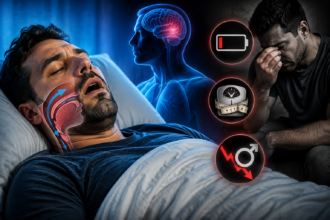


You’re not imagining it. The stubborn belly fat that won’t move no matter how clean you eat. The wired-but-exhausted feeling at 11 p.m. when your body is tired but your brain won’t shut off. The fact that you can sleep eight hours and still wake up feeling like you never slept at all. Somewhere along the way, “stressed” stopped being a mood and started being your baseline. You’ve probably already tried the obvious fixes — more sleep, more gym sessions, less coffee — and while some of it helped a little, none of it actually solved the underlying problem, because none of it touched the hormone that’s quietly running the show: cortisol.
Cortisol isn’t the villain it gets made out to be in wellness marketing. It’s a essential hormone your body needs every single day. The problem isn’t that you have cortisol — it’s that for a lot of men, it never turns off. This article breaks down what cortisol actually does, why chronic stress hits men in specific and measurable ways, how it connects to the fatigue, weight gain, and low testosterone you may already be dealing with, and exactly what the evidence says actually lowers it — not the supplement-ad version, the real one.
What Cortisol Actually Is (and Isn’t)
Cortisol is a steroid hormone produced by your adrenal glands, and it’s one of the most important hormones in your entire body. It follows a natural daily rhythm — it should be highest about 30 to 45 minutes after you wake up, giving you the alertness and motivation to get out of bed, and then gradually taper down throughout the day, reaching its lowest point in the hours before sleep so your body can wind down properly.
At healthy levels and in that healthy rhythm, cortisol does a lot of good: it regulates blood sugar, controls inflammation, supports blood pressure, and helps convert food into usable energy. It’s not something to eliminate. The issue men actually run into isn’t cortisol itself — it’s a flattened or inverted rhythm, where cortisol stays elevated when it should be dropping, or fails to rise properly in the morning, both of which are hallmarks of chronic, unmanaged stress rather than a single stressful day.
Acute Stress vs. Chronic Stress: Why the Difference Matters
A short burst of cortisol — the kind you get before a job interview, a hard conversation, or a near-miss in traffic — is a healthy, adaptive response. It sharpens focus, mobilizes energy, and then resolves once the stressor passes. This is the system working exactly as designed.
Chronic stress is a different animal entirely. It’s the low-grade, always-on pressure of a demanding job, financial strain, relationship tension, poor sleep, or simply never having a moment where your nervous system fully downshifts. When stress becomes constant rather than occasional, cortisol never gets the signal to fully reset, and your body starts treating a hormone meant for short-term emergencies as a permanent operating condition. That’s the version with real, measurable downstream consequences, and it’s the version this article is actually about.
How Chronic Cortisol Elevation Shows Up in Men Specifically
Stress physiology isn’t identical across sexes, and there’s a reasonable body of research suggesting men and women differ somewhat in both their cortisol reactivity and how they typically cope with it. Men, on average, tend to show a stronger cortisol spike in response to acute stressors, particularly performance- and achievement-related stress, and are statistically less likely to engage in the kind of social processing and help-seeking behavior that helps regulate the stress response afterward. In practice, that often means the stressor gets absorbed and pushed down rather than talked through and metabolized — which is a large part of why men’s burnout so rarely gets recognized or called burnout until something physical actually breaks down.
The result is a pattern that’s extremely common and rarely connected back to its actual cause: a man who is training hard, eating reasonably well, and still gaining fat around the midsection, still exhausted, still short-tempered, and still not sleeping properly — because the missing variable in the equation was never diet or exercise, it was a nervous system that never gets to stand down.
The Testosterone Connection
Cortisol and testosterone have what’s often described as an inverse relationship, and the mechanism is fairly direct. Both hormones are produced from the same upstream building block, and chronically elevated cortisol appears to suppress the signaling pathway that tells your testes to produce testosterone, a phenomenon sometimes referred to as the “cortisol steal” effect in less rigorous corners of the internet, though the underlying hormonal competition it’s describing is real and documented in the endocrinology literature. Studies on men under sustained psychological or physical stress — including military training, sleep deprivation, and high-pressure work environments — consistently show measurable drops in testosterone alongside sustained cortisol elevation.
This matters because it means a man chasing low energy, low libido, or stalled muscle gains by focusing exclusively on testosterone may be missing the actual lever. If you’ve already looked into the early warning signs of low testosterone, it’s worth noticing how closely that list overlaps with classic chronic-stress symptoms — because in a meaningful number of cases, they’re the same list, and lowering cortisol is what actually moves the needle on testosterone, not the other way around.
The Sleep Connection
Cortisol and sleep run on the same internal clock, and when one gets disrupted, the other follows. Elevated evening cortisol — from late-night work, doomscrolling, alcohol, or simply an overstimulated nervous system that never got the chance to downshift — directly interferes with your ability to fall asleep and reach deep, restorative sleep stages. This is a big part of why so many men can technically log eight hours in bed and still wake up depleted, a topic covered in more depth in why sleep might be the one health habit you’re still ignoring.
It’s also worth ruling out a related but distinct issue: if snoring, gasping, or witnessed breathing pauses are part of your nighttime picture, that’s a different and separate mechanism worth investigating on its own, covered in detail in the connection between sleep apnea, fatigue, and low testosterone. Chronic stress and sleep apnea can absolutely coexist and compound each other, so it’s worth being honest about which one — or both — actually applies to you.
The Belly Fat Connection
This is the one most men have experienced firsthand without ever connecting the dots. Cortisol receptors are especially dense in visceral fat — the fat stored around your abdominal organs — which means chronically elevated cortisol doesn’t just contribute to weight gain generally, it specifically favors fat storage around the midsection, independent of total calorie intake. Cortisol also increases appetite, particularly cravings for high-sugar, high-fat “comfort” foods, while simultaneously promoting insulin resistance over time, which makes fat loss in that area disproportionately difficult even when the rest of your habits are genuinely solid.
This is precisely why a man can be doing everything right on paper — tracking food, training consistently, sleeping reasonable hours — and still be stuck, because the piece that’s actually driving the stubborn midsection fat was never on the plate or in the gym log at all. It’s worth reading alongside a broader strategy for losing stubborn belly fat, since stress management isn’t a replacement for diet and training fundamentals — it’s the missing input that makes the other two actually work as intended.
Signs Your Cortisol Is Likely Chronically Elevated
You don’t need a lab test to have a reasonably informed suspicion. Be honest with yourself about how many of these currently apply:
- You feel “wired but tired” — mentally overstimulated but physically exhausted, especially in the evening
- Stubborn fat around your midsection that hasn’t responded to consistent diet and training changes
- Waking up between 2 and 4 a.m. and struggling to fall back asleep
- Getting sick more often, or taking longer than usual to recover from minor illness or injury
- Persistent low mood, irritability, or a shortened fuse over small things
- Strong cravings for sugar or salty comfort food, particularly in the afternoon or evening
- Low libido or noticeably reduced motivation, even for things you normally enjoy
- Feeling like you never fully relax, even during genuine downtime
Answering yes to several of these, especially in combination, is a meaningful signal — not proof of a diagnosis, but a legitimate reason to take the next section seriously rather than filing it under “that’s just adulthood now.”
What Actually Lowers Cortisol, Backed by Evidence
Consistent sleep timing does more for cortisol regulation than almost anything else on this list, because cortisol’s daily rhythm is directly tied to your sleep-wake cycle. Going to bed and waking up at roughly the same time every day, including weekends, helps re-anchor that rhythm far more effectively than occasional catch-up sleep.
Zone 2 cardio and low-to-moderate intensity movement — brisk walking, cycling, swimming at a conversational pace — has been shown in multiple studies to lower baseline cortisol over time, in contrast to chronic high-intensity training without adequate recovery, which can actually keep cortisol elevated in already-stressed individuals. This doesn’t mean stop lifting or stop doing hard workouts; it means make sure low-intensity movement, particularly walking, has a real place in your week, not just the hard sessions.
Controlled breathing and brief nervous-system downshifts are among the most consistently replicated stress-reduction tools in the research, specifically because they directly activate the parasympathetic nervous system, which is the physiological “off switch” that chronic stress prevents from engaging. Even five to ten minutes of slow, extended-exhale breathing has measurable effects on cortisol and heart rate variability in controlled studies. This doesn’t require an app, a retreat, or a particular belief system — it requires doing it consistently.
Sunlight exposure within the first hour of waking, ideally 10 to 15 minutes outdoors without sunglasses, helps anchor your cortisol rhythm to the correct time of day, which in turn supports proper cortisol decline in the evening and easier sleep onset — a piece that fits directly into a well-structured morning routine rather than requiring an entirely separate habit.
Social connection and actually talking about what’s stressing you is unglamorous advice, but it’s genuinely evidence-backed — studies on stress physiology consistently show that processing stress socially, rather than absorbing it silently, measurably blunts the cortisol response. This is one of the more specific, addressable gaps behind the burnout pattern many men fall into.
Adequate protein and stable blood sugar throughout the day prevent the energy crashes that themselves trigger a cortisol spike, since your body treats a sharp blood sugar drop as a legitimate stressor. Steady, protein-forward meals — the kind of approach covered in nutrition for men who train — support hormonal stability well beyond muscle-building.
Reducing or timing caffeine and alcohol matters more than most men expect. Caffeine directly stimulates cortisol release, particularly when consumed on an empty stomach or later than early-to-mid afternoon, and alcohol, despite feeling relaxing in the moment, is known to disrupt both sleep architecture and next-day cortisol regulation.
What Doesn’t Work as Well as You’ve Been Told
Cortisol-blocking supplements marketed heavily for belly fat and stress relief have, at best, weak and inconsistent evidence behind them, and at worst are simply expensive placebos riding the coattails of a real physiological phenomenon. Ashwagandha has some legitimate supporting research for mild stress reduction, but it’s a modest supporting tool, not a substitute for the fundamentals above, and it’s worth discussing with a doctor before adding it, particularly if you’re on other medications.
Pushing through with more high-intensity training when you’re already under-recovered and chronically stressed tends to backfire, keeping cortisol elevated rather than resolving it, even though it feels productive in the moment. More effort is not automatically the correct input here.
“Just relax” as a strategy without a specific practice attached to it doesn’t move the needle, because vague intentions don’t create the physiological downshift that actual breathing practices, sleep consistency, and movement do. Cortisol responds to specific inputs, not general good intentions.
A Simple 4-Week Reset Plan
Week 1 — Anchor your mornings and evenings. Get outside within an hour of waking, and set a fixed bedtime you can actually hit five to six nights a week. Nothing else changes yet.
Week 2 — Add a daily nervous-system downshift. Ten minutes of slow breathing or a quiet walk without your phone, ideally in the evening. Keep the morning and evening anchors from Week 1 going.
Week 3 — Adjust caffeine and alcohol timing. Cut caffeine off by early afternoon, and notice how alcohol — even one or two drinks — affects your next-day energy and mood. This is diagnostic as much as it is a change.
Week 4 — Add consistent low-intensity movement. Three to four sessions of brisk walking or easy cardio, on top of whatever training you’re already doing, not instead of it.
By the end of four weeks, most men notice a real, tangible difference in how “wired” the evenings feel and how refreshed mornings feel — not because any single step is magic, but because chronically elevated cortisol responds to consistent, boring, repeated signals that it’s safe to stand down, not to a single dramatic intervention.
When to See a Doctor
Self-management is appropriate for the general pattern of chronic stress described here, but certain signs warrant an actual clinical conversation rather than continued self-directed effort: significant unexplained weight gain concentrated in the face, neck, or midsection alongside muscle weakness or thinning skin, persistently high blood pressure, unexplained bruising, or mood symptoms severe enough to affect daily functioning. These can occasionally point to a distinct medical condition involving genuinely excessive cortisol production (Cushing’s syndrome), which is uncommon but diagnosable through bloodwork, and worth ruling out rather than assuming. This is also a reasonable topic to raise as part of the preventive health screening most men skip before 40, since a simple blood or saliva cortisol panel can be added to routine bloodwork without much extra effort.
The Bottom Line
Cortisol isn’t something to fear or eliminate — it’s something to bring back into rhythm. For a lot of men, the fatigue, stubborn belly fat, low libido, and short temper that get chalked up to “just stress” or “getting older” are actually a fairly specific, fairly well-understood hormonal pattern with real, unglamorous levers you can pull: consistent sleep timing, morning sunlight, controlled breathing, low-intensity movement, and actually talking to someone instead of absorbing everything silently. None of it is complicated. Almost none of it is what gets marketed to men as the solution. But it’s what the evidence actually supports, and unlike a lot of the noise around stress and hormones, it’s genuinely within your control starting tonight.
Sources
- American Psychological Association (APA), Stress Effects on the Body — apa.org
- Endocrine Society, Cortisol and the HPA Axis — endocrine.org
- National Institute of Mental Health (NIMH), 5 Things You Should Know About Stress — nimh.nih.gov
- Mayo Clinic, Chronic Stress: Symptoms and Effects on the Body — mayoclinic.org
- Journal of Clinical Endocrinology & Metabolism, Cortisol and Testosterone Interaction Under Stress — academic.oup.com/jcem
- Harvard Health Publishing, Understanding the Stress Response — health.harvard.edu
This article is for informational and educational purposes only and does not constitute medical advice, diagnosis, or treatment. If you suspect a hormonal imbalance or are experiencing symptoms that significantly affect your daily life, consult a doctor or endocrinologist for proper evaluation. See our Medical Disclaimer for details.