

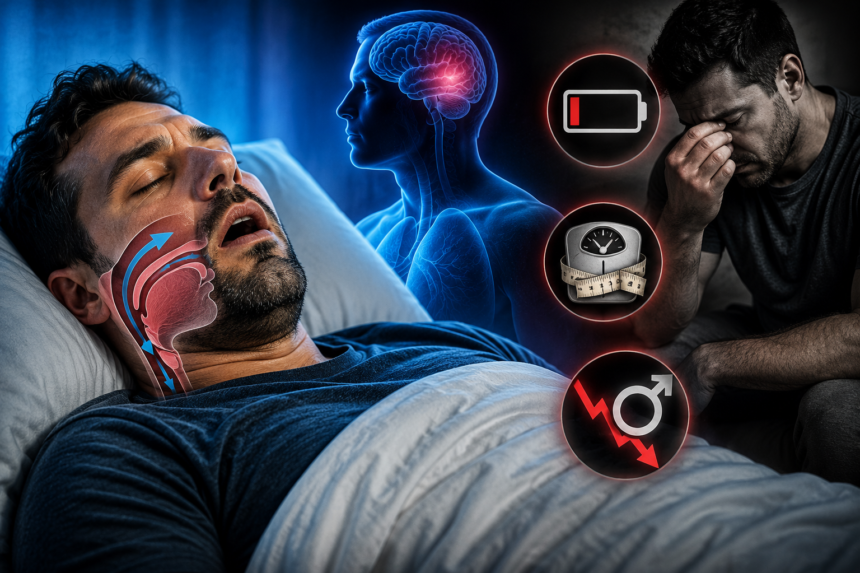
You’ve done everything the wellness articles tell you to do. You go to bed at a reasonable hour. You’ve cleaned up your morning routine. You’re eating better, training consistently, and you still wake up feeling like you got hit by a truck. Coffee helps for about an hour, then the fog rolls back in by mid-afternoon. Your partner mentions, half-joking, that you snore like a chainsaw and sometimes seem to just stop breathing for a few seconds. You’ve chalked it up to stress, age, or just “not being a morning person.” What you probably haven’t considered is that you might have a legitimate, diagnosable medical condition quietly running in the background of your life every single night — one that’s disproportionately common in men, wildly underdiagnosed, and directly connected to several other issues you may already be trying to fix separately.
That condition is obstructive sleep apnea, and it affects an estimated 26% of adults between the ages of 30 and 70 in the United States, with men diagnosed at roughly two to three times the rate of women. It’s also estimated that up to 80% of moderate-to-severe cases go completely undiagnosed, which means a huge number of men reading this article right now may be living with a real, treatable medical condition and simply don’t know it. This piece breaks down what sleep apnea actually is, why men specifically are at higher risk, how it connects to testosterone, weight, heart health, and the fatigue you might already be trying to solve through better sleep hygiene alone, and exactly what the path to diagnosis and treatment actually looks like.
What Sleep Apnea Actually Is, In Plain Terms
Sleep apnea is a condition in which your breathing repeatedly stops and starts throughout the night, sometimes dozens or even hundreds of times, often without you ever fully waking up or remembering it happened. There are two main types, and the distinction matters.
Obstructive sleep apnea (OSA) is by far the more common type, and it’s a mechanical problem: the soft tissue at the back of your throat — your tongue, soft palate, and the muscles supporting your airway — relaxes during sleep to the point where it partially or fully collapses, physically blocking airflow. Your brain detects the drop in oxygen, briefly jolts you into a lighter stage of sleep just enough to tighten those muscles and reopen the airway, and then the cycle repeats. This happens so briefly and so often that most people never consciously wake up or remember it, even though their sleep architecture has been shredded into dozens of fragments over the course of the night.
Central sleep apnea is far less common and works differently: instead of a physical blockage, the brain temporarily fails to send the proper signals to the muscles that control breathing. It’s more often associated with specific underlying conditions like heart failure or certain neurological issues, and it’s diagnosed and treated somewhat differently than the obstructive form. Because OSA accounts for the vast majority of cases, and the vast majority of what’s relevant to a general male audience, that’s the primary focus for the rest of this article.
Severity is measured using something called the Apnea-Hypopnea Index (AHI), which counts the average number of breathing interruptions per hour of sleep. Mild is generally classified as 5 to 15 events per hour, moderate as 15 to 30, and severe as more than 30 — which means someone with severe sleep apnea could be experiencing a breathing interruption roughly every other minute, all night, every night, for years, without ever being fully aware it’s happening.
Why Men Are Hit Harder Than Women
The gender gap in sleep apnea isn’t a diagnostic bias or an awareness issue alone — although both of those play a role — it’s also rooted in real anatomical and hormonal differences that make men structurally more vulnerable to the condition.
Fat distribution patterns play a significant role. Men are statistically more likely to carry excess weight around the neck, throat, and upper body — the “apple” pattern of fat storage — compared to women’s more common hip-and-thigh distribution. Extra soft tissue around the neck and throat directly narrows the airway and adds weight that makes it more likely to collapse during sleep, which is part of why neck circumference specifically (rather than just overall body weight) is one of the strongest predictors clinicians use to estimate OSA risk.
Airway and craniofacial anatomy also differ on average between men and women, with men generally having longer, more collapsible upper airways and different jaw and soft palate structure — differences that exist independent of body weight and that partly explain why even lean, fit men can still develop significant sleep apnea.
Hormones cut in both directions here, which is where this condition starts connecting to something else covered elsewhere on this site. Testosterone itself appears to influence airway muscle tone and fat distribution in ways that may increase apnea risk, while at the same time — and this is the part most men have never heard — untreated sleep apnea directly suppresses testosterone production, creating a genuinely vicious cycle worth understanding in detail.
The Testosterone Connection Nobody Explains Clearly
If you’ve already looked into the early warning signs of low testosterone — fatigue, low libido, difficulty building muscle, brain fog, mood changes — you may have noticed that list overlaps almost point-for-point with the classic symptoms of sleep apnea. That’s not a coincidence. It’s because the two conditions are mechanically linked, and untreated sleep apnea is one of the more overlooked, reversible contributors to low testosterone in men who otherwise have no obvious hormonal cause.
The majority of your daily testosterone production happens during deep, uninterrupted sleep, particularly during REM cycles. Sleep apnea, by definition, prevents you from ever reaching or sustaining those deep sleep stages — every time your airway collapses and your brain has to briefly rouse you to reopen it, you get yanked back toward lighter sleep, and the deep-sleep window where testosterone production peaks simply never gets the uninterrupted time it needs. Multiple clinical studies have found measurably lower testosterone levels in men with moderate-to-severe untreated OSA compared to men without the condition, and — importantly for anyone currently on hormone therapy — testosterone replacement therapy itself can, in some cases, worsen underlying sleep apnea, which is part of why a sleep evaluation is now a standard part of responsible clinical workup before or during TRT.
This creates a frustrating loop for a lot of men: low energy and low libido lead them toward investigating testosterone as the root cause, and testosterone alone gets addressed, without anyone ever asking whether disrupted sleep is the actual upstream driver. Fixing the sleep apnea, in a meaningful number of cases, allows testosterone levels to improve on their own — meaning some men chasing a hormone problem are actually chasing a breathing problem wearing a hormone problem’s symptoms.
Why “Just Get More Sleep” Isn’t the Same Fix
If you’ve read about why sleep is the one health habit men keep ignoring, you already understand that sleep quantity and consistency genuinely matter for energy, hormones, and long-term health — and everything in that argument is true and worth acting on. But sleep apnea reveals the limit of that advice on its own: this is a condition where you can technically be in bed for eight or nine hours, following every sleep hygiene rule in the book, and still wake up exhausted, because the problem was never how long you were lying there — it was how many times your body was quietly forced awake and starved of oxygen during that window.
This is precisely why sleep apnea is so easy to miss and so easy to misattribute to something else. It doesn’t look like classic insomnia. You fall asleep fine, you technically stay asleep for a normal number of hours, and you have no memory of anything disrupting you — which is exactly what makes it feel like a stress problem, an age problem, or a “just need more caffeine” problem rather than a specific, diagnosable medical condition with a name and a treatment path.
The Full Symptom List: What to Actually Watch For
Snoring gets all the pop-culture attention, but it’s just one signal among several, and plenty of men with sleep apnea don’t even realize how many of these apply to them until they see the list laid out together.
Nighttime signs, often only noticed by a partner: loud, chronic snoring, especially with pauses followed by gasping or choking sounds; witnessed episodes of stopped breathing; restless tossing and turning; waking up gasping or with a sensation of choking; frequent nighttime urination (a lesser-known but well-documented symptom, since disrupted sleep and pressure changes in the chest during apneic events affect certain hormones involved in fluid regulation).
Daytime signs, the ones most men actually notice but rarely connect to sleep: persistent fatigue and low energy despite adequate hours in bed; morning headaches, caused by the repeated overnight drops in blood oxygen; difficulty concentrating or noticeable brain fog, sometimes described as feeling mentally “slow” or forgetful; irritability or low mood; falling asleep during passive activities like reading, watching TV, or — seriously worth taking note of — while driving; and a general sense that no amount of sleep actually feels restorative.
If several of these sound familiar, it’s worth being honest with yourself about how many you’re currently dismissing as “just how I am now.”
Risk Factors Beyond Weight
Excess weight is the single most well-known risk factor, and it’s a real and significant one — but it’s far from the only one, and treating sleep apnea as purely a weight problem causes a lot of lean, otherwise fit men to rule themselves out incorrectly.
Neck circumference specifically, independent of overall weight, is one of the strongest individual predictors — a neck circumference greater than 17 inches (43 cm) in men is generally flagged as a meaningful risk indicator in clinical screening tools. Age increases risk steadily, as throat muscle tone naturally decreases over time, which connects directly to why the preventive health checklist most men skip before 40 is worth taking seriously well before symptoms feel urgent. Family history and jaw/airway anatomy — a naturally narrow airway, a recessed jaw, or enlarged tonsils — can put even young, lean, healthy men at meaningful risk. Alcohol use, especially in the hours before bed, relaxes throat muscles further and measurably worsens apnea severity, even in people who don’t drink heavily overall. Smoking increases airway inflammation and fluid retention in the throat, compounding the mechanical collapse risk. Nasal congestion or chronic sinus issues, whether from allergies or structural problems like a deviated septum, force harder breathing effort that can contribute to airway collapse. And sleeping on your back specifically allows gravity to pull the tongue and soft palate backward, worsening obstruction compared to side-sleeping.
The Health Risks of Leaving It Untreated
This is the part of the sleep apnea conversation that deserves more attention than the “you’ll be tired” framing usually gives it, because untreated OSA is linked to serious downstream health consequences that go well beyond daytime grogginess.
Cardiovascular strain is the most well-documented risk. Every apneic event causes a sharp, repeated drop in blood oxygen followed by a stress-hormone surge as your body forces itself awake to breathe again — a pattern that happens dozens or hundreds of times a night and, over years, is strongly associated with high blood pressure, irregular heart rhythms like atrial fibrillation, heart attack, and stroke. Multiple large studies have found that untreated moderate-to-severe OSA roughly doubles the long-term risk of major cardiovascular events compared to no OSA.
Metabolic effects compound the weight-gain risk factor into a genuine feedback loop: poor sleep quality disrupts the hormones that regulate hunger and satiety (ghrelin and leptin), increasing appetite and cravings, particularly for high-calorie food, while simultaneously reducing the energy and motivation available for exercise — making OSA both a consequence of weight gain and, independently, a driver of further weight gain and insulin resistance.
Cognitive and mental health effects include measurably increased risk of depression and anxiety in people with untreated OSA, alongside documented impacts on memory, concentration, and reaction time — the last of which connects to a genuinely serious and underappreciated risk: drowsy driving. Multiple studies have found that drivers with untreated sleep apnea have a significantly elevated crash risk compared to the general population, on par with some legal blood alcohol limits in terms of reaction-time impairment.
Testosterone and reproductive health, as covered above, take a direct hit, along with documented associations between untreated OSA and reduced fertility markers in some studies.
None of this is meant to alarm you into a panic — it’s meant to make clear why this is worth actually getting checked rather than quietly managing around with more coffee and willpower, the same way you’d take a persistent chest pain seriously rather than assuming it’s nothing.
How Sleep Apnea Actually Gets Diagnosed
The path to diagnosis is more accessible than a lot of men assume, and it usually starts with a conversation rather than an intimidating hospital procedure.
Start with your primary care doctor. Bring the specific symptoms — snoring, gasping, daytime fatigue, morning headaches, a partner’s observations — rather than a vague “I’m tired all the time,” since specific symptom patterns are what actually prompt a referral. A validated screening questionnaire, most commonly the STOP-BANG assessment, is often used as a quick first-pass risk estimate based on snoring, tiredness, observed apneas, blood pressure, BMI, age, neck size, and gender.
The definitive diagnosis comes from a sleep study, called polysomnography, which measures breathing patterns, oxygen levels, heart rate, and brain activity throughout the night. This traditionally happens at an accredited sleep lab, but a large and growing share of diagnoses now happen through validated at-home sleep testing kits — a small, wearable device you use for one or two nights in your own bed, which is significantly more accessible, less expensive, and less disruptive than an overnight lab stay, and is considered clinically appropriate for many, though not all, suspected cases.
The output is your AHI score, which determines both the diagnosis and the severity classification described earlier, and directly shapes which treatment path makes sense for your specific situation.
Treatment Options, From First-Line to Advanced
This is genuinely one of the more treatable chronic conditions in modern medicine once it’s actually identified, with options ranging from lifestyle changes to well-established medical devices.
Weight management, where excess weight is a contributing factor, can meaningfully reduce or in some milder cases resolve OSA, since even a modest reduction in neck and throat tissue can be enough to reduce nighttime airway collapse — which is part of why sleep apnea and long-term weight strategy are worth thinking about together rather than as separate projects, and where the discipline behind an effective, sustainable morning routine or a structured approach to intermittent fasting can genuinely support the broader goal, alongside — not instead of — proper medical treatment for the apnea itself.
CPAP (Continuous Positive Airway Pressure) remains the gold-standard, first-line treatment for moderate-to-severe OSA. The device delivers a steady stream of pressurized air through a mask worn during sleep, which mechanically keeps the airway open and prevents the collapses that cause apneic events. It has a reputation, not entirely undeserved, for being uncomfortable or inconvenient to adjust to — but modern CPAP machines are dramatically quieter, smaller, and more comfortable than older models, with a wide range of mask styles available, and the reported improvement in energy, mental clarity, and even mood among consistent users is often described as one of the more immediately noticeable medical interventions a person can experience.
Oral appliance therapy is a well-established alternative, particularly for mild-to-moderate cases or for men who genuinely cannot tolerate CPAP: a custom-fitted device, similar to a mouthguard, worn during sleep that repositions the jaw and tongue forward to keep the airway open. It’s less universally effective than CPAP for severe cases but represents a significantly more convenient option for many men with milder OSA.
Positional therapy addresses cases where apnea is specifically or significantly worse when sleeping on your back, using specialized wearable devices or positioning aids that discourage back-sleeping throughout the night.
Surgical options exist for specific anatomical causes — enlarged tonsils, a significantly deviated septum, or other structural airway obstructions — and are generally considered when other treatments haven’t sufficiently addressed a clearly identifiable anatomical cause, rather than as a first-line approach.
Lifestyle adjustments that meaningfully help alongside primary treatment include reducing alcohol intake in the hours before bed, quitting smoking, treating nasal congestion or allergies, and, for many men, simply switching from back-sleeping to side-sleeping.
A Practical Self-Check
Ask yourself honestly whether the following apply to you, keeping in mind that you may genuinely not know the answer to the nighttime ones without asking a partner or roommate directly:
- Has anyone told you that you snore loudly or seem to stop breathing during sleep?
- Do you wake up feeling unrefreshed, even after seven-plus hours in bed?
- Do you regularly get morning headaches?
- Do you struggle with concentration, memory, or brain fog during the day?
- Have you ever caught yourself nearly dozing off while driving or during a quiet, passive activity?
- Is your neck circumference above roughly 17 inches (43 cm)?
- Do you carry noticeable excess weight around your neck and midsection?
- Do you regularly wake up to urinate multiple times a night?
Answering yes to several of these, particularly the snoring and daytime fatigue items together, is a genuine, specific reason to bring this up with a doctor — not a vague “maybe someday” concern to keep pushing down the list.
Where This Fits Into the Bigger Picture
Sleep apnea rarely shows up as an isolated issue — it tends to sit at the intersection of several things men are already trying to manage separately. The chronic fatigue and irritability it causes can look a lot like the pattern described in men’s burnout that never gets called burnout, where stress-driven exhaustion and physiological exhaustion get lumped together and treated as a mindset problem rather than investigated separately. It directly undermines the value of an otherwise solid morning routine, since no amount of discipline around wake-up time and habits can compensate for sleep that was never actually restorative to begin with. And it belongs squarely in the kind of proactive screening most men skip until something forces the issue — exactly the pattern worth breaking well before your 40s rather than after.
When to See a Doctor Without Waiting
Certain signs warrant a more prompt conversation with a healthcare provider rather than sitting on the list above indefinitely: witnessed pauses in breathing during sleep, choking or gasping awakenings, excessive daytime sleepiness severe enough to affect driving safety or work performance, or the combination of loud snoring with high blood pressure or a known heart condition. None of these require you to have this figured out yourself first — describing the symptoms honestly to a doctor is the entire first step, and screening tools exist specifically because self-diagnosis isn’t the expectation.
The Bottom Line
Sleep apnea is one of the more common, more consequential, and more fixable conditions quietly affecting men’s health right now, and the gap between how many men actually have it and how many are diagnosed is enormous. If persistent fatigue, brain fog, low libido, or stalled progress on weight and energy have been resistant to every lifestyle fix you’ve tried, it’s worth asking a genuinely different question than “what am I doing wrong” — namely, whether something is happening while you sleep that no amount of daytime effort can compensate for. Getting screened is a low-effort, low-risk first step, and for a condition this common and this treatable, the honest first move for a lot of men reading this is simply asking a partner one direct question tonight: do I stop breathing when I sleep?
Sources
- American Academy of Sleep Medicine (AASM), Obstructive Sleep Apnea Clinical Guidelines — aasm.org
- National Heart, Lung, and Blood Institute (NHLBI), Sleep Apnea — nhlbi.nih.gov
- Mayo Clinic, Obstructive Sleep Apnea: Symptoms and Causes — mayoclinic.org
- Centers for Disease Control and Prevention (CDC), Sleep and Sleep Disorders — cdc.gov
- Journal of Clinical Sleep Medicine, Testosterone and Obstructive Sleep Apnea: A Review — jcsm.aasm.org
- American Heart Association (AHA), Sleep Apnea and Cardiovascular Disease — heart.org
This article is for informational and educational purposes only and does not constitute medical advice, diagnosis, or treatment. Sleep apnea is a medical condition that requires proper evaluation and diagnosis by a qualified healthcare provider. If you suspect you may have sleep apnea, or if you experience symptoms such as loud snoring, witnessed breathing pauses, or excessive daytime sleepiness, consult a doctor or sleep specialist. See our Medical Disclaimer for details.