
You already know what you’re supposed to eat. You’ve read about hitting your protein targets, you’ve sorted out when to eat that protein, maybe you’ve even worked out whether you need creatine, protein, or both. The nutrition science isn’t the problem. The problem is Tuesday at 7 p.m., when you’re exhausted, hungry, and the fastest option on the table is whatever’s in the drive-through window.
That gap — between what you know and what you actually eat on a busy weeknight — is where most men’s diets quietly fall apart. Not from a lack of knowledge, but from a lack of a system. Meal prep is that system. Done right, it’s not meal-in-a-box bodybuilder food eaten cold out of Tupperware. It’s a repeatable weekly process that makes the healthy choice the easy choice, so your nutrition doesn’t depend on how much willpower you have left after a ten-hour day.
This guide walks through a complete, realistic meal prep system built specifically around what men who train actually need: enough protein to support muscle, enough fiber and micronutrients to support long-term health, and enough flexibility that you’ll actually stick with it past week two.
Why Meal Prep Matters More Than Another Diet Plan
Most nutrition advice focuses on what to eat. Meal prep solves a different problem: when and how you’ll actually eat it. That distinction matters more than it sounds.
Decision fatigue is real. By the time you’ve made a hundred small decisions at work, deciding what to cook — and then actually cooking it — is often the decision that loses. Restaurant food, delivery apps, and vending machines exist precisely to catch you in that moment of low willpower, and they rarely serve up the protein-to-fiber ratio your body needs.
Meal prep removes the decision entirely. If the food is already cooked, portioned, and sitting in your fridge, the “easy” option and the “healthy” option become the same option. You’re not relying on discipline at 7 p.m. on a Tuesday — you’re relying on a decision you already made on Sunday, when you had the time and headspace to make a good one.
There’s a compounding effect here too. Consistency, not perfection, is what drives results in body composition, energy levels, and long-term health markers. A single “perfect” day of eating does almost nothing. Forty consistent, good-enough days in a row changes how you look, feel, and perform. Meal prep is the single highest-leverage habit for turning nutrition knowledge into that kind of consistency.
The Four Pillars of a Meal Prep Plate
Before building a weekly system, it helps to know what you’re actually trying to put on the plate. Every meal you prep should hit some combination of these four pillars.
Protein. This is the anchor of every meal, both for muscle maintenance and growth and for keeping you full. Chicken breast and thighs, lean ground beef, eggs, canned tuna, Greek yogurt, and cottage cheese are the workhorses of meal prep because they hold up well after reheating. For a full breakdown of which sources are worth prioritizing, our guide to the best protein sources for muscle gain ranks them by protein quality, cost, and versatility.
Fiber. This is the pillar most meal-prepped diets get wrong, because high-protein staples like chicken and eggs contain essentially none of it. Beans, lentils, oats, roasted vegetables, and whole grains need to be built into the plan deliberately, not left as an afterthought. If you want the full case for why this matters beyond digestion — including its link to cholesterol, blood sugar, and even hormone health — it’s worth reading our deep dive on fiber for men.
Smart carbohydrates. Rice, potatoes, quinoa, and oats fuel training sessions and refill glycogen. How many of these you prep depends on your goal and activity level, which we’ll cover in the muscle gain vs. fat loss section below.
Healthy fats and micronutrients. Olive oil, avocado, nuts, and fatty fish bring in the fats your hormones need to function, along with a chunk of your daily micronutrient intake. If you’re not sure which vitamins and minerals matter most for men specifically, our micronutrient blueprint covering magnesium, zinc, vitamin D, and omega-3 is the companion piece to this guide.
A meal that’s missing one of these four pillars isn’t wrong, but a week built entirely around meals missing the same pillar will show up on your energy levels, your digestion, or your bloodwork eventually.
How Much You Actually Need: A Starting-Point Framework
You don’t need to weigh every almond to make meal prep work, but having rough targets makes portioning at the start of the week much faster.
Protein: A commonly used starting point for men actively training is roughly 0.7 to 1 gram of protein per pound of body weight per day (about 1.6–2.2 g/kg), spread across three to five meals. Our protein timing guide breaks down how to distribute that across the day for better muscle protein synthesis.
Fiber: Adult men generally do best aiming for 30 to 38 grams per day. Most meal-prepped, protein-heavy diets land well below that unless fiber sources are prepped with the same intention as protein sources.
Carbohydrates and fats: These should flex based on your goal, training volume, and total calorie target. As a rough starting frame, many men do well with carbs making up 30–45% of calories and fats 25–35%, adjusted from there based on how they perform and feel.
Calories overall: Meal prep works for any calorie target — surplus, maintenance, or deficit — because it’s a delivery system, not a diet. The system stays the same; only the portion sizes and ratios change.
If any of this feels overwhelming to calculate precisely, don’t let it stall you. Start with the “protein and fiber on every plate” rule below, track how you feel and perform for two to three weeks, and adjust portions from there instead of trying to hit exact numbers on day one.
The Weekly Meal Prep System, Step by Step
This is the actual repeatable process — the part most guides skip in favor of just listing recipes.
Step 1: Pick One Prep Day
Sunday works for most schedules, but Wednesday is just as valid if your week splits into two halves. The goal is one 90-minute to two-hour block where you batch-cook everything at once, rather than cooking every single night.
Step 2: Choose Two to Three Protein Bases
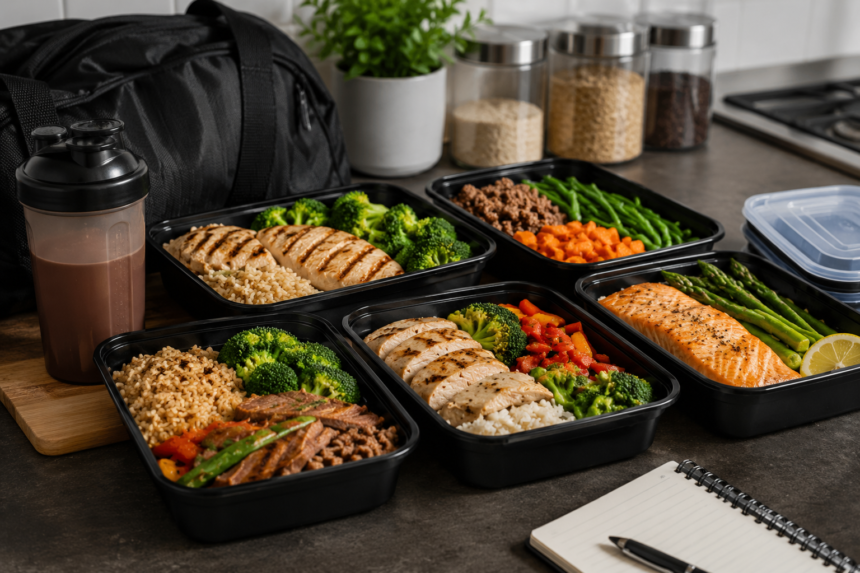
Cooking the same chicken breast five nights in a row is the fastest way to quit meal prep. Instead, cook two or three different proteins in bulk — for example, a tray of baked chicken thighs, a pot of ground beef or turkey seasoned two different ways, and a batch of hard-boiled eggs. Rotating proteins across the week keeps meals from feeling repetitive without adding real prep time, since you’re still only cooking once.
Step 3: Batch-Cook Your Carbs and Fiber Sources Together
Rice, quinoa, or potatoes can go in the oven or a rice cooker while your protein is cooking. At the same time, cook a large batch of beans or lentils and roast a full sheet pan of vegetables — broccoli, Brussels sprouts, and peppers all hold up well through the week. This is the step most men skip, and it’s exactly why fiber intake quietly collapses on a meal-prepped diet. Treat your fiber source with the same non-negotiable status as your protein source.
Step 4: Portion Immediately, Not Later
Portion everything into containers right after cooking, while it’s already out and you’re already in “cooking mode.” Waiting until later to portion is where prepped food turns into a pile of separate dishes nobody wants to reassemble on a Tuesday night.
Step 5: Build in Flexibility With a “Mix and Match” Station
Instead of assembling seven identical meals, keep your proteins, carbs, and vegetables in separate containers and combine them fresh each day. This single change does more for long-term adherence than any recipe swap — it prevents the “I’m sick of this exact meal” burnout that kills most meal prep routines by week three.
Step 6: Prep Your Fats and Extras Separately
Sauces, dressings, avocado, and nuts don’t always hold up well pre-mixed into a container for five days. Prep these in small separate containers or add them fresh at mealtime to keep texture and flavor from degrading.
Step 7: Keep a Rotating “Emergency Snack” Stock
Even the best system has gaps — a missed lunch, a longer-than-expected workday. Keep a stash of fiber-forward, protein-supportive snacks on hand so a gap in your plan doesn’t turn into a drive-through run. Our list of healthy snacks for weight loss is built around exactly this use case.
Best Foods to Stock for Meal Prep
Proteins that hold up well: chicken breast and thighs, lean ground beef or turkey, eggs, canned tuna and salmon, Greek yogurt, cottage cheese, tofu and tempeh.
Carbs that reheat well: brown rice, quinoa, farro, sweet potatoes, regular potatoes, whole wheat pasta.
Fiber and vegetables that survive the week: roasted broccoli, Brussels sprouts, carrots, bell peppers, black beans, lentils, chickpeas.
Fats to add fresh: avocado, olive oil, almonds, walnuts, chia and flax seeds.
Freezer-friendly backups: frozen vegetables, pre-cooked frozen grains, and a batch of soup or chili frozen in individual portions for the weeks life gets in the way of prep day entirely.
If a food you’re relying on is shelf-stable rather than fresh — protein powder is the obvious example for a lot of men who train — it’s worth knowing how to tell when it’s actually gone bad rather than guessing. Our guide on whether protein powder can go bad covers the shelf life and storage side of that question.
Sample 7-Day Meal Prep Plan
This isn’t a rigid meal plan — it’s an example of how the “mix and match” system plays out across a real week, built around two prepped proteins, two prepped carbs, and two prepped fiber/vegetable sources.
Sunday prep session produces:
- Baked chicken thighs (2 lbs)
- Seasoned ground beef (1.5 lbs)
- Roasted sweet potatoes (large batch)
- Cooked quinoa (large batch)
- Roasted broccoli and bell peppers (full sheet pan)
- Cooked black beans (large batch)
- 6 hard-boiled eggs
Monday: Chicken, quinoa, roasted broccoli, drizzle of olive oil.
Tuesday: Ground beef, sweet potato, black beans, avocado added fresh.
Wednesday: Chicken, black beans, roasted peppers, a squeeze of lime.
Thursday: Ground beef, quinoa, broccoli, handful of almonds on the side.
Friday: Chicken, sweet potato, roasted peppers, hot sauce.
Weekend: Cook fresh, use hard-boiled eggs and remaining prepped items as backup for a busy weekend meal, or use the freezer stash if the week ran long.
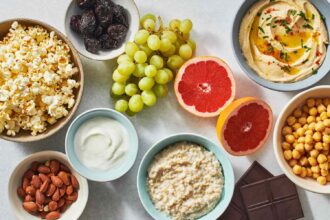
Snacks throughout the week: Greek yogurt with berries, a handful of nuts, or an air-popped popcorn or veggies-and-hummus option to keep fiber and appetite control going between meals.
Notice what’s happening structurally here: two proteins and two carb sources, rotated across five different flavor combinations using sauces, spices, and fresh add-ins. That’s the entire trick to not getting bored of meal prep — it’s four or five cooked components combined in different ways, not seven separate meals cooked from scratch.
Meal Prep for Muscle Gain vs. Fat Loss
The system stays identical. What changes is the ratio.
If you’re prioritizing muscle gain, lean into slightly larger portions of your prepped carb sources — rice, potatoes, quinoa — to support training volume and recovery, while keeping protein consistent across all meals. This pairs directly with the training side of the equation; if you’re following a structured plan like a push/pull/legs split or working through our guide on how to build muscle fast, your meal prep portions should scale with how much you’re training that week.
If you’re prioritizing fat loss, keep protein where it is (it’s the last thing you want to cut) and lean harder into the fiber and vegetable side of the plate to control hunger at a lower calorie intake. This is where meal prep earns its keep the most — fiber-forward, protein-anchored meals are far easier to stay consistent with in a deficit than trying to white-knuckle hunger through an unplanned day. Our guides to body recomposition and losing stubborn belly fat both lean on this same principle: the plan that wins is the one you can actually follow on a bad week, not just a good one.
Either way, resist the urge to build an entirely different set of recipes for “bulking” versus “cutting.” Changing the size of the scoop is far easier to sustain than overhauling your entire kitchen routine every time your goal shifts.
Food Safety and Storage: The Rules That Actually Matter
Meal prep only works if the food is still safe to eat by Thursday. A few rules cover almost every real-world risk:
Cool food before sealing containers. Sealing hot food traps steam, which creates condensation and speeds up bacterial growth. Let food cool for about 20–30 minutes before portioning into airtight containers.
Refrigerate within two hours of cooking. Food left at room temperature for longer than that sits in the temperature range where bacteria multiply fastest.
Most cooked meals are good for three to four days in the fridge. Beyond that window, freeze the remainder rather than pushing your luck. Cooked rice and grains are a common overlooked risk — reheat them thoroughly, and don’t leave them at room temperature to cool slowly.
Label and rotate your freezer stash. Frozen backups are only useful if you actually know what’s in the container and when it went in. A piece of tape and a marker solves this in ten seconds.
Reheat to steaming hot, not just warm. This matters more for poultry and ground meat than for vegetables or grains.
None of this requires special equipment — just glass or BPA-free plastic containers, a fridge thermometer if you want to be precise, and the discipline to actually eat the oldest container first.
Common Meal Prep Mistakes Men Make
Cooking one giant meal instead of modular components. Seven identical containers of the exact same meal is the single biggest reason men quit meal prep by Wednesday. Modular prep — proteins, carbs, and vegetables stored separately — solves this.
Forgetting fiber entirely. A week of chicken, rice, and nothing green is a fiber deficit waiting to happen. Build a vegetable or legume into every single prepped meal, not just when it’s convenient.
Over-preparing and under-eating. Cooking five days of food and then eating out twice anyway wastes money and food. Be realistic about how many meals you’ll actually eat at home versus on the go, and prep to that number instead of an idealized version of your week.
Skipping variety in seasoning. The food itself doesn’t need to change every day — the sauce, spice blend, or side dish does. Keep three or four different seasoning profiles in rotation (a Mexican-style blend, a garlic-herb blend, a spicy option) to keep the same base ingredients from feeling monotonous.
Not accounting for a bad week. Life happens. Keeping a frozen backup batch of a simple meal — chili, a soup, or a stir-fry — means one missed prep Sunday doesn’t derail the whole system.
Budget-Friendly Meal Prep Tips
Meal prep is one of the few nutrition habits that gets cheaper the more consistently you do it, because you’re buying in bulk and wasting almost nothing.
- Buy chicken thighs and whole chickens instead of pre-trimmed breast when budget matters — they’re consistently cheaper per gram of protein.
- Dried beans and lentils cost a fraction of canned versions and take one extra step (an overnight soak) to prepare.
- Frozen vegetables are nutritionally comparable to fresh in most cases and dramatically cut food waste since nothing wilts in the fridge before you get to it.
- Eggs remain one of the cheapest complete protein sources available and require zero prep skill.
- Buy grains — rice, oats, quinoa — in bulk bags rather than small boxes; the per-serving cost drops significantly.
- Plan your prep around what’s on sale that week rather than a fixed recipe, and rotate your protein and vegetable choices accordingly.
Frequently Asked Questions
How long does meal-prepped food actually last in the fridge?
Most cooked proteins, grains, and vegetables stay safe and taste good for three to four days. Freeze anything you won’t eat within that window rather than pushing it to day five or six.
Is meal prep only for bodybuilders or people trying to gain muscle?
No. The system is just as effective — arguably more effective — for fat loss and general health, since it removes the daily decision fatigue that leads to impulsive, lower-quality food choices.
Do I need special containers or equipment?
Airtight glass or BPA-free plastic containers are enough. A rice cooker and sheet pans make the process faster, but neither is required to get started.
What if I get bored eating the same meals?
This almost always comes from cooking identical, pre-assembled meals rather than modular components. Rotating two or three proteins, two carbs, and a few different sauces or seasoning blends solves boredom without adding real cooking time.
Can I meal prep and still eat out sometimes?
Yes, and you should plan for it rather than treating it as a failure. Prep enough meals to cover your typical at-home days and leave room for the social or unplanned meals that are a normal part of life.
How do I know if my meals are hitting my protein and fiber targets?
Track your intake with a nutrition app for a week early on. Most men are surprised by how far off their estimate is until they actually measure it — this is true for fiber especially, as covered in our fiber for men guide.
The Bottom Line
Meal prep isn’t a diet, and it isn’t a shortcut around eating well — it’s the delivery system that makes everything else you already know about nutrition actually happen on a Tuesday night when you’re tired. Anchor every meal with protein, don’t let fiber and vegetables become an afterthought, batch-cook in modular pieces instead of identical meals, and keep a backup plan in the freezer for the weeks that don’t go as planned.
Get that system running consistently for a month, and it will do more for your body composition, energy, and consistency than any single “perfect” diet plan you could follow for a week and then abandon.
Sources
This article draws on general nutrition guidance from the following types of sources. It does not cite individual studies and is not a substitute for personalized dietary advice:
- U.S. Department of Agriculture (USDA), Dietary Guidelines for Americans
- National Institutes of Health (NIH), Office of Dietary Supplements
- Harvard T.H. Chan School of Public Health, The Nutrition Source
- Academy of Nutrition and Dietetics
- U.S. Food and Drug Administration (FDA), food storage and food safety guidance
Medical Disclaimer
This article is for informational and educational purposes only and does not constitute medical, nutritional, or dietetic advice. It is not a substitute for professional consultation, diagnosis, or treatment. Individual nutrition needs vary based on age, activity level, medical history, and health conditions. Always consult a physician, registered dietitian, or other qualified healthcare provider before making significant changes to your diet, starting a new eating plan, or if you have a pre-existing medical condition, food allergy, or take medication that may interact with dietary changes. Never disregard professional medical advice or delay seeking it because of something you have read in this article.