

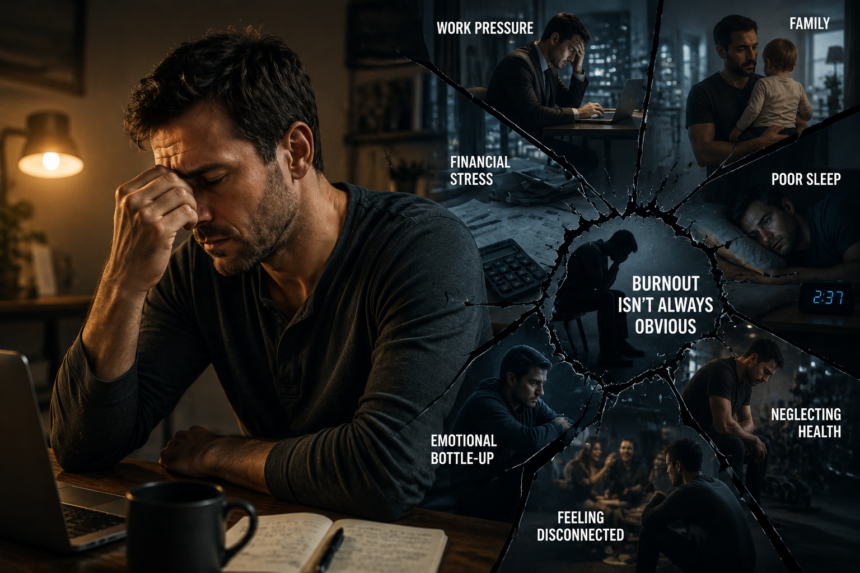
I didn’t notice I was burning out. My wife did. I’d stopped laughing at things that used to make me laugh, I was short with my kids over nothing, and I’d started telling myself that feeling exhausted by 3pm every day was just what being thirty-something with a job and a mortgage felt like. It took her saying, flatly, “you haven’t seemed like yourself in months” for me to actually stop and look at what was going on.
That’s the thing about burnout in men. It almost never shows up labeled as burnout. It shows up as a shorter temper, a few extra drinks most nights, skipped workouts you keep meaning to get back to, and a low hum of exhaustion that coffee stops touching. By the time most guys use the word “stressed,” they’ve usually been running on empty for months, and by the time they’d call it “burnout,” they’ve often been running on empty for a year or more.
This isn’t a mental health lecture. It’s a practical, detailed rundown of what chronic stress actually does to a man’s body and mind, why it hides so well behind normal-looking behavior, what’s usually driving it underneath the surface, and what genuinely helps, not the “just meditate” advice that ignores how most men actually live, work, and think.
Why Men’s Stress Looks Different
Most stress and burnout messaging is written around symptoms that show up more visibly in women, sadness, tearfulness, openly talking about feeling overwhelmed. Men’s stress tends to externalize instead. It comes out as irritability, withdrawal, overworking, or a spike in risk-taking behavior, drinking more, driving more aggressively, picking fights over small things that would have rolled off your back a year ago. None of that reads as “stressed” to the people around you, and it often doesn’t read that way to you either.
There’s also a simple habit gap behind this. Men are statistically less likely to talk about what they’re feeling, less likely to seek support before things get serious, and more likely to try to just push through it. That’s not a character flaw, it’s a pattern reinforced by how a lot of us were raised to handle difficulty: quietly, alone, and without complaint. Somewhere along the way, “I’m fine” became the default answer regardless of whether it was true, and it stayed the default answer for so long that a lot of men lose the habit of checking in with themselves at all.
The problem is that chronic stress doesn’t respond well to being ignored. It doesn’t level off on its own once you get used to it. It compounds, quietly, in the background, while you keep functioning well enough that nobody, including you, flags it as a real problem.
The Signs You’re Probably Missing
Here’s the list I wish someone had handed me a year before my wife said something. None of these on their own means much. Several of them together, sustained for weeks at a time, is the actual signal worth paying attention to.
- A shorter fuse than usual. Getting disproportionately irritated by small things, traffic, a slow app, your kid asking the same question twice, is one of the most reliable early markers of chronic stress in men. It’s often the first sign anyone else notices, usually before you do.
- Exhaustion that sleep doesn’t fix. Not tired-because-you-stayed-up-late tired, but a heavy, low-grade fatigue that’s still there after a full night’s sleep, and that coffee only masks for an hour or two before it comes back.
- Losing interest in things you used to enjoy. Not dramatically, just quietly not bothering anymore, the hobby, the workout, the friend you used to call. This is one people rationalize the longest, usually as “I’ve just been busy.”
- A creeping increase in “coping” habits. An extra drink most nights, more scrolling, more snacking late at night, small numbing behaviors that didn’t used to be part of your routine and that you’d struggle to explain if someone asked why you started them.
- Trouble concentrating on anything that isn’t urgent. Chronic stress narrows your focus to whatever feels like the immediate fire, and everything else, reading, planning, actual rest, gets harder to sit still for, even when you have the time.
- Physical symptoms with no clear cause. Tension headaches, a tight jaw or clenched teeth, stomach issues, chest tightness, or a resting heart rate that’s crept up. Worth mentioning to a doctor to rule out anything else, but also worth connecting honestly to your stress load.
- Feeling flat around people you care about. Going through the motions with your partner, kids, or friends without the emotional presence you used to bring, present in the room but not really there.
- A shrinking window of patience for your own mistakes. Small errors that never used to bother you, a typo, a forgotten errand, start triggering an outsized wave of frustration or self-criticism.
- Waking up already tired, or already anxious. Instead of waking up neutral and building energy through the morning, you wake up with the day’s weight already sitting on your chest before you’ve done anything.
- A vague sense that something’s off, without being able to name it. Sometimes there’s no single symptom, just a background feeling that things aren’t quite right, paired with an inability to point to why.
If three or more of these have been true for more than a few weeks, that’s not a bad month. That’s a signal worth acting on, not waiting out.
What’s Actually Driving It
Chronic stress rarely comes from one dramatic event. It’s usually an accumulation of smaller loads that never got a chance to drain, stacked on top of each other until the total exceeds what you can absorb quietly. A few of the most common contributors worth actually naming instead of lumping together as “just stress”:
- Chronic low-grade financial pressure. Not necessarily a crisis, just a persistent undercurrent of not having quite enough margin, which keeps your nervous system mildly activated even when nothing acute is happening.
- Role overload. Being the primary provider, a hands-on parent, a reliable friend, and someone trying to maintain their own health, all at once, with no role ever fully “off.”
- Suppressed conflict. Tension at work or at home that never gets addressed directly tends to sit in the body as ongoing low-grade stress rather than resolving.
- Loss of autonomy. Feeling like your schedule, your decisions, or your time belong to everyone except you is one of the most consistently cited drivers of burnout across occupational health research.
- Identity tied entirely to output. When your sense of worth is built almost entirely around performance, work, income, physical achievement, every dip in performance starts to feel like a threat to who you are, not just a bad week.
- No real recovery built into your week. Not a lack of free time necessarily, but a lack of time that isn’t quietly still work, planning, or obligation dressed up as rest.
Recognizing which of these are actually driving your specific stress matters, because the fix for financial pressure looks different from the fix for role overload, and generic stress advice tends to ignore that distinction entirely.
What Chronic Stress Actually Does to Your Body
This isn’t just an in-your-head problem, and treating it that way is part of why so many men ignore it until it shows up somewhere physical.
Sustained stress keeps cortisol elevated for longer than it’s meant to be. Cortisol is supposed to spike in response to an acute threat and then drop back down once the threat passes, that’s the system working correctly. Chronic stress keeps it elevated instead, and prolonged elevated cortisol is linked to disrupted sleep, increased abdominal fat storage even without a change in diet, suppressed immune function, elevated blood pressure, and, over time, reduced testosterone production.
That last one matters more than most men realize. Chronic stress and poor sleep are two of the most common, and most fixable, contributors to low energy and low libido in men under 40, often ahead of anything hormonal going on independently of lifestyle. It’s also worth noting that elevated cortisol and reduced testosterone tend to reinforce each other in both directions, meaning the longer chronic stress goes unaddressed, the harder each individual symptom becomes to shift on its own.
Beyond hormones, chronic stress is also associated with a heightened inflammatory response throughout the body, which is part of why people under sustained stress tend to get sick more often, heal more slowly, and report more aches and general physical discomfort than they did during less stressful periods, even without any single diagnosable cause.
What Chronic Stress Does to Your Brain and Decisions
It also affects decision-making in a very literal, mechanical way, not just a vague “stress makes you cranky” way. Chronic stress shifts activity away from the prefrontal cortex, the part of your brain responsible for planning, weighing consequences, and impulse control, and toward the amygdala and other structures responsible for reactive, fight-or-flight responses.
That’s why stressed people make worse decisions under pressure, snap more easily at people they care about, struggle to think several steps ahead, and find it harder to sit with discomfort instead of immediately reacting to it. It isn’t a willpower problem. It’s a nervous system that’s been stuck in a reactive mode for so long that the more deliberate, thoughtful parts of your thinking simply get less airtime.
This also explains a pattern a lot of stressed men recognize but rarely connect to stress specifically: making impulsive purchases, snapping at a partner over something trivial, or abandoning a plan halfway through, then feeling confused or frustrated with themselves afterward for reacting “out of character.” It isn’t out of character. It’s exactly the character your brain produces when it’s been running in threat-response mode for months.
Why “Just Relax” Doesn’t Work
Generic stress advice fails most men for a specific reason: it treats stress as an emotional state to manage rather than a physiological one to discharge. Telling someone who’s wound up from twelve-hour days and no real downtime to “just relax” is like telling someone with a full inbox to “just stop getting emails.” The advice isn’t wrong in theory, it’s just aimed at the wrong layer of the problem.
The more useful frame is this: stress is energy your body mobilized for a threat that never got physically resolved. Historically, that mobilized energy got burned off through actual physical exertion, running, fighting, working the land, carrying, building. Modern stress, a bad email, a tense meeting, financial pressure, a difficult conversation you’re avoiding, triggers the same physiological mobilization with almost no physical outlet attached to it. The tension has nowhere to go, so it sits in your body and shows up as the symptoms above, tight shoulders, a clenched jaw, a short temper, restless sleep.
That reframe matters because it points toward what actually works: not just calming down mentally, but giving that mobilized energy somewhere real to go, which is a very different intervention than simply trying to think your way into feeling calmer.
The Stress-Sleep-Testosterone Loop
This deserves its own section because it’s one of the most under-discussed cycles in men’s health, and it’s a big part of why chronic stress feels so hard to escape once it takes hold.
Chronic stress elevates cortisol, which disrupts the depth and quality of sleep, particularly the deep, slow-wave sleep where most physical recovery and hormone regulation happens. Poor sleep, in turn, further elevates cortisol the next day and independently suppresses testosterone production, since the majority of daily testosterone release happens during sleep itself. Lower testosterone and disrupted sleep both reduce your resilience to stress, meaning the next stressful event hits harder and lingers longer than it would have with a well-rested, well-regulated system underneath it.
The result is a self-reinforcing loop: stress worsens sleep, worse sleep worsens hormonal regulation and stress resilience, and reduced resilience makes the next stressor feel bigger than it objectively is. This is exactly why so many men report that once they finally address their sleep seriously, their stress tolerance improves noticeably within a few weeks, not because the external stressors changed, but because the system absorbing them got measurably stronger.
A Simple Self-Check
Before jumping to solutions, it’s worth actually taking stock rather than guessing. Ask yourself these questions honestly, ideally writing the answers down rather than just thinking them:
- In the last month, how many days did you wake up feeling genuinely rested, not just awake?
- How many times in the last two weeks did you feel disproportionately irritated by something minor?
- Is there anything you used to enjoy that you’ve quietly stopped doing, without a specific reason why?
- Has anyone close to you commented, even lightly, that you seem different, more tired, more short-tempered, more distant?
- When was the last time you had an hour that was fully yours, with no obligation attached to it, even loosely?
- Have you noticed yourself reaching for a drink, your phone, or food specifically to feel different rather than because you wanted it?
There’s no scoring system here. The point is simpler than that: if answering these honestly is uncomfortable, or if you notice yourself deflecting rather than answering, that discomfort is itself useful information.
What Actually Helps
None of this requires quitting your job or overhauling your life. It requires a few specific, unglamorous habits done consistently, layered on top of each other rather than tried one at a time in isolation.
Move your body daily, even briefly. This is the single most effective lever most men have, and the one most consistently skipped when time gets tight. It doesn’t need to be a full workout, a 20-minute walk, a short lifting session, or a bike ride discharges mobilized stress hormones in a way that sitting and thinking about your problems never will. If you’re rebuilding a fitness habit from scratch, The Science-Backed Morning Routine for Maximum Energy and Productivity covers how to anchor movement into a morning that’s already busy, rather than trying to find a new hour that doesn’t exist.
Protect your sleep like it’s a non-negotiable meeting. Given the loop described above, this is arguably the highest-leverage single change most stressed men can make. Sleep debt and stress feed each other directly, poor sleep raises cortisol, and elevated cortisol makes it harder to fall and stay asleep. Breaking that cycle usually matters more than anything else on this list. Why Sleep Might Be the One Health Habit You’re Still Ignoring goes deep on exactly this loop and how to actually fix it.
Name it to one person. Not necessarily a therapy session, just saying out loud to a partner, friend, or family member that you’ve been stretched thin. It sounds small. It consistently ranks among the most effective, and most avoided, interventions men have available, mostly because it requires admitting something’s off before it’s an emergency, and admitting it out loud is often the hardest part.
Cut one thing instead of adding five. Stressed people tend to respond to stress by adding more, more supplements, more apps, more self-improvement projects, all of which quietly become one more obligation. Usually the higher-leverage move is removing one real source of load: a commitment you resent, a habit that’s quietly draining you, an obligation you’ve outgrown but kept out of habit or guilt.
Build in actual recovery, not just downtime. Scrolling your phone for an hour isn’t recovery, it’s low-effort stimulation that often leaves you more depleted, not less. Real recovery looks like something that fully occupies your attention away from work: a hobby with your hands, time outdoors, a conversation with no agenda, something with a natural stopping point that doesn’t quietly bleed into more screen time.
Get regular, unstructured time outdoors. Even fifteen minutes of daylight exposure, ideally in the morning, helps regulate the same cortisol rhythm that chronic stress disrupts, and it’s one of the few interventions with almost no barrier to entry or cost.
Track one thing for two weeks. Not everything, just one metric, hours slept, or days you moved your body, or how many times you felt genuinely present with your family. A small amount of honest tracking makes gradual change visible in a way that’s hard to notice otherwise, since chronic stress tends to distort your sense of how you’re actually doing over time.
Rebuild one social connection deliberately. Chronic stress tends to shrink your world down to work and immediate obligations, and reconnecting with even one friend or family member on a regular basis, a standing call, a monthly dinner, meaningfully buffers stress in a way that’s well documented and consistently underused.
Stress at Work Specifically
Work deserves its own mention because it’s the single most commonly cited source of chronic stress in men, and because a lot of general stress advice doesn’t account for the specific dynamics of a job you can’t simply walk away from.
A few things worth doing specifically around work-related stress: build in a genuine transition ritual between work and home, even five minutes, changing clothes, a short walk, a few minutes of silence in the car before going inside, rather than carrying the last work thought straight through your front door. Get clear, even just for yourself, on which parts of your workload are within your control and which aren’t, since a large share of work stress comes from treating uncontrollable variables as if they were personal failures. Set one honest boundary around after-hours availability, even something as small as not checking email after a specific time, and hold it consistently rather than “when possible.”
If your workload has been genuinely unsustainable for months rather than weeks, that’s worth raising directly with a manager or HR before it becomes a health issue rather than after, since most workplaces respond better to an early, calm conversation framed around sustainability and output than to an eventual crisis, a resignation, or a sudden drop in performance they didn’t see coming.
What Not to Do
A few common responses tend to make chronic stress worse rather than better, even though they feel productive in the moment:
- Trying to outwork it. Throwing yourself harder into work as a way of avoiding everything else usually delays the reckoning rather than preventing it, and often adds to the load that caused the problem in the first place.
- Relying on alcohol as your primary decompression tool. It reliably makes sleep quality worse even when it feels like it helps you fall asleep faster, which quietly deepens the stress-sleep loop described above.
- Waiting for a “less busy” period that never comes. Most men who say they’ll address their stress “once things calm down” are still waiting a year later, because the underlying pattern that created the stress rarely resolves itself without a deliberate change.
- Treating it as purely a mindset problem. Positive thinking alone doesn’t lower cortisol or fix a genuine sleep deficit. The physiological layer needs physiological interventions, not just a better attitude layered on top of an unchanged routine.
- Isolating further as things get harder. The instinct under stress is often to withdraw and handle it alone, which is exactly backwards, since connection is one of the most consistently effective buffers against chronic stress that exists.
When to Stop Managing It Yourself
Self-management is the right starting point, but it isn’t always enough, and there’s no weakness in recognizing that. It’s worth talking to a doctor or a mental health professional if any of the following are true: the symptoms above have persisted for more than a month despite genuinely trying to address them, you’ve noticed a real increase in drinking or other coping behaviors, you’re having trouble functioning at work or in your relationships, physical symptoms are getting worse rather than better, or you’ve had any thoughts of harming yourself.
A primary care doctor is a completely reasonable first stop, and can rule out physical causes and refer you further if needed. This isn’t a sign you’ve failed at handling it. It’s the same logic as seeing a doctor for a knee that isn’t healing on its own, some things respond better to expert help than to willpower and good intentions alone.
Frequently Asked Questions
How is burnout different from just being tired?
Regular tiredness usually resolves with rest and a good night’s sleep. Burnout is a deeper, more persistent state that doesn’t fully lift with rest alone and typically comes with irritability, reduced motivation, and a sense of detachment from things you’d normally care about. If a weekend off doesn’t meaningfully help, that’s a sign it’s more than ordinary fatigue.
Can stress actually lower testosterone?
Yes. Chronically elevated cortisol has an inverse relationship with testosterone production, and poor sleep, which chronic stress worsens, independently suppresses it further. For many men, addressing stress and sleep together moves the needle on energy and libido more than any supplement would on its own.
Is it normal to feel fine emotionally but still have physical stress symptoms?
Very common, and one of the main reasons men’s stress goes unnoticed for so long. Physical symptoms, tension, fatigue, digestive issues, a short temper, often show up well before someone consciously registers feeling “stressed” or “burned out” in words.
What’s the fastest way to bring stress down in the moment?
Physical movement is the quickest reliable reset, even a brisk 10-minute walk measurably lowers cortisol and shifts your nervous system out of a reactive state. Slow, deliberate breathing works too, but for most men, moving the body works faster and requires less concentration in the moment than a breathing exercise does.
How long does it take to actually recover from burnout?
It varies widely depending on how long the underlying pattern has been running, but most men who consistently apply sleep, movement, and workload changes notice a meaningful shift within four to eight weeks. Full recovery, especially if it involves resetting hormonal regulation and rebuilding genuine recovery habits, often takes several months of sustained change rather than a quick fix.
Can burnout come back after you’ve recovered from it once?
Yes, especially if the underlying driver, an unsustainable workload, an unaddressed relationship pattern, a lack of built-in recovery, never actually got resolved and you just felt better for a while. Treating recovery as a permanent fix rather than an ongoing practice is one of the most common reasons burnout returns within a year or two.
Should I see a doctor or a therapist first?
Either is a reasonable starting point. A primary care doctor can rule out physical contributors and refer you onward, while a therapist can address the stress and coping patterns directly. If you’re unsure, start with whichever relationship you already have, most doctors can point you toward the right next step from there.
This article is for informational purposes and doesn’t replace the advice of a health professional, nutritionist, or physician. If you have a pre-existing medical condition or questions about your specific situation, consult a specialist before making major changes to your diet or supplementation.