
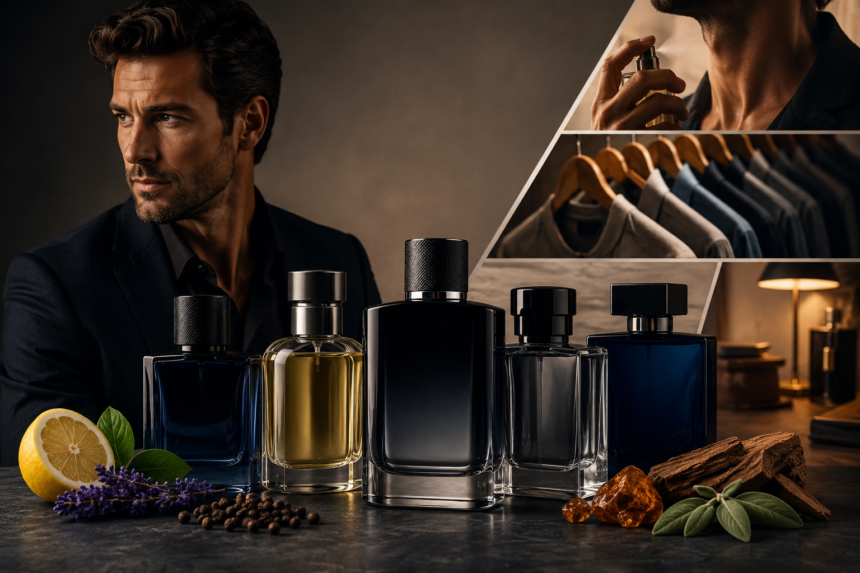
Walk into any department store fragrance counter and you’ll understand why so many guys give up before they even start. Rows of bottles, none of them labeled with anything useful, a salesperson spraying paper strips faster than you can process them, and a price tag that makes you wonder if you’re buying perfume or a small appliance. So most men default to whatever they got as a gift five Christmases ago, spray it the same way every single day, and wonder why nobody ever seems to notice. Cologne is one of the last frontiers of men’s grooming that most guides gloss over, probably because it feels more like an art than a routine. But the truth is that choosing, applying, and making a fragrance last is a skill just like dialing in a skincare routine or figuring out the right beard length for your face shape, and once you understand the mechanics behind it, it stops being guesswork.
This guide walks through everything that actually matters: how fragrance concentration works, how to pick a scent that suits you instead of the guy standing next to you at the counter, where to apply it so it actually projects, and the small habits that separate a cologne that vanishes by lunch from one that people lean in to ask you about hours later.
Why Most Men Get Fragrance Wrong From the Start
The biggest mistake happens before a single spray hits the skin: buying based on the bottle, the celebrity endorsement, or a five-second sniff test in a crowded store where your nose is already overwhelmed by a dozen competing scents. Fragrance is chemistry that interacts with your individual skin, and a cologne that smells incredible on a testing strip can smell completely different, sometimes unrecognizably so, once it warms up against your body heat.
The second common mistake is treating cologne like a finishing touch you slap on as you’re walking out the door, the same way you might grab your keys. In reality, fragrance works best as the final step of a grooming routine that starts with clean, moisturized skin. If you’ve already built out the basics of a proper skincare routine, you’re actually most of the way toward making your cologne perform better, because dry or oily skin changes how a scent develops and how long it survives on you. If you haven’t locked that down yet, it’s worth reading through our guide on building a men’s skin care routine for beginners before diving deeper into fragrance, since the two work together more than most guys realize.
The third mistake, and probably the most damaging to how a scent is perceived by other people, is overcorrecting. Because fragrance receptors in your nose become desensitized to a scent you wear regularly (a phenomenon called olfactory fatigue), many men assume they’re not wearing enough and pile on more, when in reality everyone around them can smell it perfectly well from across the room. This single habit is often the difference between someone being remembered for smelling great and being remembered for the wrong reasons entirely, and it’s a pattern that shows up again and again in lists of grooming habits that quietly undermine a man’s appearance, the kind we’ve broken down in our piece on common grooming mistakes that ruin your appearance.
Understanding Fragrance Concentration: EDT, EDP, and Parfum Explained
Before you can choose a scent intelligently, you need to understand what’s actually written on the bottle, because concentration determines everything from how long a fragrance lasts to how strong it smells up close versus from a distance.
Eau Fraiche sits at the lowest end of the spectrum, typically containing only one to three percent fragrance oil diluted mostly in water. These are light, often used as body sprays, and rarely last more than an hour or two. They’re fine for a quick refresh but shouldn’t be relied on as your main fragrance.
Eau de Cologne (EDC), despite lending its name to the entire category, technically refers to a lighter formulation with around two to five percent fragrance oil. Classic citrus-forward colognes historically fell into this category, and they tend to last two to three hours before fading significantly.
Eau de Toilette (EDT) is the most common concentration you’ll find in mainstream men’s fragrances, sitting around five to fifteen percent fragrance oil. This is a solid, versatile choice for daily wear, offering four to six hours of noticeable presence without being overwhelming, which makes it the safest default for office environments or situations where you’re in close proximity to other people for extended periods.
Eau de Parfum (EDP) steps up to roughly fifteen to twenty percent concentration, delivering a richer, more complex scent that typically lasts six to eight hours or longer. EDP is generally the better choice for evenings, dates, or colder months, when scent molecules don’t evaporate as quickly and you want something with more depth and staying power.
Parfum or Extrait de Parfum sits at the top, with concentrations often exceeding twenty percent and sometimes reaching thirty or forty percent in niche and luxury releases. These are the longest-lasting, most intimate formulations, often designed to be smelled up close rather than projected across a room, and a single application can realistically last a full day.
Understanding this hierarchy matters because two bottles of the exact same fragrance name, one labeled EDT and one labeled EDP, will behave completely differently on your skin. If you’ve ever bought a cologne, loved it in the store, and felt disappointed that it disappeared within an hour of wearing it, there’s a good chance you grabbed the EDT or EDC version without realizing a stronger concentration existed.
The Four Main Fragrance Families and What They Say About You
Fragrances are broadly grouped into families based on their dominant characteristics, and understanding these categories makes shopping infinitely easier because you can walk into a store already knowing roughly what you’re looking for instead of starting from zero.
Fresh and Citrus
This family includes scents built around notes like bergamot, lemon, grapefruit, and often aquatic or marine accords. These fragrances tend to be light, clean, and universally likeable, which makes them excellent for daytime wear, professional settings, and warmer months. They project a sense of cleanliness and approachability but generally don’t have the depth or complexity to stand out in a memorable way, and they tend to fade faster than heavier families due to the volatile nature of citrus molecules.
Woody
Built around notes like cedar, sandalwood, vetiver, and oud, woody fragrances offer warmth and a grounded, masculine character without being overpowering. This family works well across seasons and occasions, making it one of the safest starting points if you’re building your first serious fragrance collection. Woody scents tend to have excellent longevity because the base notes that define the family are naturally heavier and slower to evaporate.
Aromatic and Fougère
This is the classic “barbershop” family, built around lavender, herbs, and often a mossy or slightly sweet undertone. It’s a category with deep roots in traditional men’s fragrance and tends to smell distinctly masculine to most noses, even people with no fragrance background. It’s a strong choice if you want something that reads as timeless rather than trend-driven.
Oriental and Amber
The boldest of the four families, oriental fragrances lean on warm, spicy, sweet notes like vanilla, amber, cinnamon, and resins such as frankincense or benzoin. These are statement scents, best suited for evenings, colder weather, and situations where you want to be noticed rather than blend in. They tend to have exceptional longevity and sillage (the trail of scent left behind as you move), but they’re also the easiest family to overapply, since their intensity means a little goes further than you’d expect.
Most men eventually find that they gravitate toward one or two of these families more than the others, and recognizing your preference is the fastest shortcut to narrowing down an overwhelming market into a manageable shortlist.
How to Actually Test a Fragrance (Without Wasting Money)
The department store method of spraying five different scents on paper strips and sniffing them in rapid succession is almost guaranteed to give you the wrong answer, because your nose can only accurately process two or three distinct scents before fatigue sets in and everything starts smelling muddled or identical.
A better approach starts with narrowing your options down to no more than two or three fragrances based on notes and family before you ever leave the house, using online descriptions and reviews to filter out anything that clearly isn’t in your preferred category. Once you’re at the counter, test on skin rather than paper. Paper strips give you an idea of the top notes, but they can’t replicate how a fragrance interacts with your individual body chemistry, oil production, and skin pH, all of which genuinely change how a scent smells once it’s actually on you.
Apply your top pick to one wrist and, if you’re still deciding between two, your second choice to the opposite forearm rather than stacking them on the same spot. Then walk away. Do errands, browse other stores, and let the fragrance develop naturally over the next two to four hours. This is essential because a fragrance’s character changes as it moves through three distinct stages, and judging it in the first five minutes only tells you about the first of those three stages.
The top notes are what you smell immediately after application, usually bright and often citrus or herbal, but they evaporate within fifteen to thirty minutes. The heart notes, sometimes called middle notes, emerge over the following one to two hours and represent the core character of the fragrance, typically floral, spicy, or fruity. The base notes are what remain after several hours once the lighter molecules have evaporated, usually woody, musky, or resinous, and this is genuinely what the fragrance will smell like on you for the majority of the time you’re wearing it. Buying a cologne based purely on how the top notes smell in a store is a bit like judging a movie by its opening two minutes.
Where to Apply Cologne for Maximum Projection
Application technique is where most men leave performance on the table, often without realizing it. Fragrance needs warmth to diffuse into the air around you, which is why pulse points, areas where blood vessels sit close to the skin’s surface and generate more heat, are the ideal application zones.
The classic spots are the insides of both wrists, the base of the throat, and behind the ears. Some fragrance enthusiasts also recommend the inner elbows and the back of the knees for special occasions, since these areas generate warmth throughout the day and release scent gradually as you move. What you should avoid is rubbing your wrists together after applying, a habit almost everyone picks up without thinking. The friction generates heat that breaks down the fragrance’s top notes prematurely and can actually distort the scent’s development, causing it to smell slightly different than intended.
Spraying into your hair, or lightly misting the air in front of you and walking through the cloud, are two techniques favored by fragrance enthusiasts because hair holds scent exceptionally well and disperses it gradually throughout the day. Just be cautious with alcohol-based fragrances directly on colored or chemically treated hair, since the alcohol content can be drying.
A frequently overlooked detail: apply cologne immediately after showering, while your skin is still slightly damp and your pores are open. Fragrance oils bind more effectively to hydrated skin than dry skin, which directly translates into better longevity throughout the day. This is another reason fragrance and skincare are so closely linked; a well-moisturized face and body genuinely make the cologne you’re already wearing perform noticeably better, without spending an extra cent on a stronger bottle.
How Much Is Too Much: The Two to Four Spray Rule
For most eau de toilette and eau de parfum concentrations, two to four sprays total, distributed across your pulse points, is sufficient for all-day wear without overwhelming the people around you. This might sound sparse if you’re used to spraying generously, but remember that fragrance intensifies as it warms against your skin over the following twenty to thirty minutes, so what smells subtle immediately after application will bloom into something noticeably stronger within the half hour.
A simple, reliable test: if you can still smell your own cologne clearly an hour after applying it, you’ve likely applied the right amount or possibly slightly too much, since your own nose adapts to a scent faster than anyone else’s does. If a coworker three feet away comments on your cologne without you actively bringing it up, that’s generally a sign you’ve overshot into “too much” territory, unless the fragrance is specifically designed as a bold evening scent meant to project further.
Extrait de parfum and other high-concentration formulations require even less, often just one or two sprays, because their intensity is significantly higher per spray than a diluted EDT.
Making Your Fragrance Last Longer
Beyond applying to freshly moisturized, damp skin, a few additional habits genuinely extend how long a fragrance survives throughout the day.
Layering with matching scented products is one of the most effective and underused techniques. Many fragrance houses release matching shower gels, body lotions, or aftershaves alongside their signature scent, and using an unscented or matching-scented moisturizer as a base before applying cologne creates a stronger foundation for the fragrance to cling to. Even using a completely fragrance-free moisturizer works well, since the goal is hydration, not competing scent molecules.
Storage matters more than most people assume. Heat, light, and humidity are the three enemies of fragrance longevity and quality over time. A bottle stored on a sunny bathroom windowsill, subjected to daily temperature swings from hot showers, will degrade noticeably faster than one kept in a cool, dark drawer or closet. Fragrance oils oxidize when exposed to light and heat, which can shift the scent’s character over months and shorten its lifespan on your skin even when freshly applied.
Avoid rubbing after application entirely, not just at the wrists. Let the fragrance air-dry naturally on your skin rather than patting or rubbing it in, since this preserves the top notes and allows the fragrance to develop as the perfumer intended.
Reapplication strategy matters for long days. Rather than doubling up in the same spots, which can create an overwhelming, unbalanced scent as fresh top notes clash with already-developed base notes, consider applying a small top-up to a fresh pulse point, like the inner elbow, if you need to extend wear into the evening.
Building a Small Fragrance Wardrobe Instead of One Bottle
Once you’ve found a signature scent you love, it’s tempting to stop there and wear it exclusively for years. There’s nothing wrong with having a true signature, something people specifically associate with you, but most men eventually benefit from having two or three fragrances in rotation, each suited to different contexts.
A practical starting wardrobe includes one fresh, lighter fragrance for daytime, work, and warmer months; one woody or aromatic fragrance that works as a reliable year-round option for most social situations; and one bolder, oriental or amber-leaning fragrance reserved for evenings, dates, or colder weather, when its stronger projection actually suits the setting rather than overwhelming it. This kind of intentional rotation is a natural extension of the same thinking behind building a complete grooming routine in the first place, matching your habits to the actual context of your day rather than doing the same thing regardless of circumstance. If you haven’t yet mapped out that bigger picture, our complete men’s grooming routine guide is a useful companion piece to this one, since fragrance really is the final layer on top of everything else you’re already doing for your skin, hair, and beard.
You don’t need to buy three full-price bottles to build this wardrobe immediately. Fragrance sample sets and decant services, which sell smaller quantities of full-size bottles at a fraction of the price, are a low-risk way to test whether a scent earns a permanent place in your collection before committing to a full bottle that might sit half-used on a shelf for years.
Conclusion
Cologne rewards the same kind of deliberate, informed approach that pays off everywhere else in grooming: understanding what you’re actually buying, applying it with intention rather than habit, and giving it the conditions it needs to perform at its best. Concentration determines how long a scent lasts and how it projects. Fragrance families give you a shortcut to finding what genuinely suits your taste instead of wandering a store blindly. Testing on skin rather than paper, and waiting to judge a scent until its base notes emerge, will save you from bottles you regret buying. And a handful of small habits, applying to damp skin, resisting the urge to overspray, storing your bottles properly, can be the difference between a fragrance that quietly disappears by noon and one that people remember you by. Treat it as seriously as the rest of your routine, and it stops being a mystery and starts being one of the most effective, least expensive ways to leave a lasting impression.