

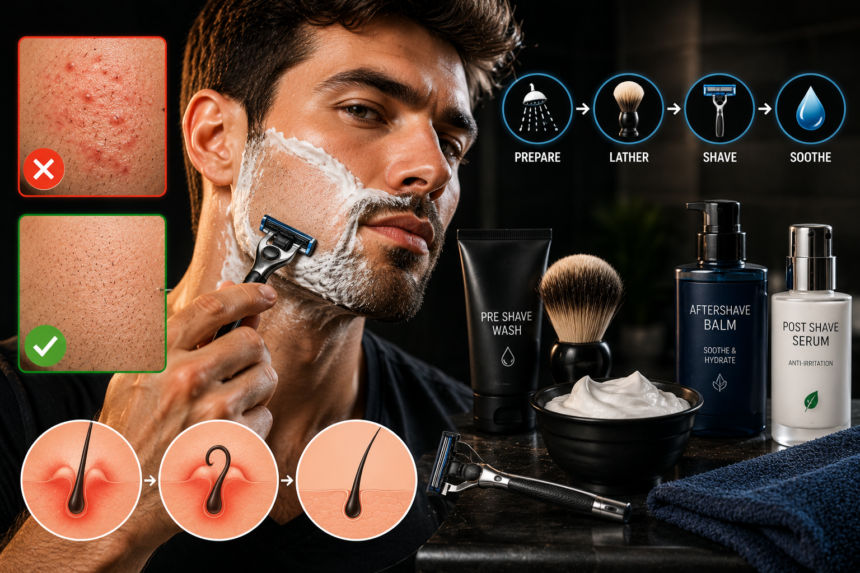
Shaving should take five minutes and leave you looking sharp. Instead, for a huge number of guys, it ends with red bumps, stinging patches, and little trapped hairs that show up two days later looking like a rash. If that sounds familiar, you are not doing anything unusually wrong — you are just missing a few details that make all the difference between a smooth shave and an angry neck.
This guide breaks down exactly why razor burn and ingrown hairs happen, what to do before, during, and after you shave to avoid them, and how to treat the ones you already have. We will also cover what to do if your skin and hair type make you especially prone to bumps, since that changes the advice quite a bit.
Razor Burn vs. Ingrown Hairs: What’s the Difference
People use these terms interchangeably, but they are two different problems with two different fixes.
Razor burn shows up right after you shave. It is surface-level irritation caused by the blade scraping against your skin, and it usually looks like redness, tightness, small red bumps, or a burning sensation. It is essentially a mild form of friction damage, similar to a rug burn, and it typically calms down within a few hours to a day.
Ingrown hairs take longer to appear. They happen when a cut hair curls back and grows sideways into the skin instead of straight out, or when dead skin cells clog the follicle opening and trap the hair underneath. Your body reacts to that trapped hair like it would to a splinter, forming a small, often painful, red or white bump that can last for days or even weeks if left alone.
Knowing which one you are dealing with matters because razor burn is mostly about calming inflamed skin, while ingrown hairs need you to physically free the trapped hair and stop new ones from getting stuck. Many of the common men’s grooming mistakes that damage your skin over time — like shaving too aggressively or skipping prep — are the same root causes behind both problems.
Why This Happens to Some Guys More Than Others
A few factors stack the odds against certain skin and hair types.
Curly or coarse hair is the single biggest risk factor. Straight hair grows out of the follicle and away from the skin. Curly hair grows out and then curves, which makes it far more likely to re-enter the skin nearby, especially once the tip has been cut at a sharp angle by a razor.
Dry, dehydrated skin loses flexibility, which means dead skin cells build up faster around the follicle opening and are more likely to trap a growing hair before it even breaks the surface.
Shaving too close — going against the grain, using too much pressure, or doing multiple passes over the same area — cuts the hair below the skin’s surface. A hair cut flush or below the surface has a much easier path to growing sideways than one cut cleanly at skin level.
Dull blades drag and tug at hair instead of cutting it cleanly, which increases both irritation and the odds of a hair snapping at an angle that encourages ingrown growth.
Friction from clothing or tight collars can also irritate freshly shaved skin on the neck, which is part of why so many guys get bumps specifically along the jawline and neck rather than the cheeks.
Pre-Shave Prep: Where Most Guys Go Wrong
The shave itself only takes a few minutes, but the prep work is what actually prevents most of the damage. Skipping it is one of the fastest ways to end up with irritated skin, no matter how good your razor is.
Shave at the end of your shower, not at the start. A few minutes of warm water and steam softens the hair shaft by up to 70 percent, which means the blade has to do far less work to cut through it. Softer hair equals a cleaner cut and dramatically less tugging.
Exfoliate two to three times a week, ideally the night before or the morning of a shave. A gentle scrub or a washcloth with light pressure clears away the dead skin cells sitting on top of your follicles, which gives the blade a clear path and reduces the odds of trapping a hair as it grows back. Just don’t exfoliate and shave on the exact same pass — do it as a separate step, then rinse before applying shaving cream.
Skip the bar soap. Soap strips natural oils and does nothing to help the blade glide. Use a proper shaving cream or gel with slip, and let it sit on your skin for a full minute before you start shaving. That extra sixty seconds gives the product time to fully soften the hair, and it is the easiest upgrade most guys can make to an existing routine.
Shaving Technique That Actually Protects Your Skin
Technique matters more than the price of your razor. Here is what changes the outcome.
Always shave in the direction the hair grows, known as shaving “with the grain.” Run your fingers lightly over your stubble before you start — you will feel which direction feels smooth and which feels rough. Rough is against the grain. Going with the grain gives you a slightly less close shave, but it cuts the hair at skin level instead of below it, which is the single biggest factor in preventing ingrown hairs.
Use short strokes and let the razor do the work. Pressing hard does not give you a closer shave, it just increases friction and the odds of nicking your skin. A sharp blade needs almost no pressure at all.
Rinse the blade after every one or two strokes. A clogged razor drags instead of cutting, and dragging is exactly what causes both burn and ingrown hairs.
If you want a closer shave, do a very light second pass across the grain (not against it) only in areas that still feel rough, rather than going against the grain everywhere. Save straight against-the-grain shaving for special occasions, not your daily routine, since it is the most irritating option by far.
Replace your blade every five to seven shaves, or sooner if you notice it starting to pull. A dull blade is one of the most underrated causes of irritation, and it is also one of the cheapest fixes available.
Choosing the Right Razor for Sensitive Skin
The right tool makes this whole process easier. A single, sharp blade with good geometry will almost always outperform a five-blade cartridge for guys prone to bumps, since fewer blades means less repeated friction across the same patch of skin per stroke.
Electric shavers are worth considering if you deal with ingrown hairs regularly, because most foil and rotary shavers cut hair slightly above the skin’s surface rather than below it, which meaningfully lowers ingrown hair risk even if the shave feels a touch less close. If you want a full breakdown of which models handle sensitive skin best, our guide to the best electric razors for men compares options specifically for irritation-prone skin.
If you prefer a manual razor, look for one with a single or double blade rather than four or five, and pair it with a pivoting head that follows the contours of your jaw and neck without you needing to press down.
Post-Shave Care That Prevents Bumps Before They Start
What you do in the two minutes after shaving matters almost as much as the shave itself.
Rinse with cool water immediately after your last pass. This helps close the pores and calms down surface-level inflammation before it has a chance to build.
Skip anything with alcohol. Traditional aftershave splashes feel refreshing, but the alcohol dries out and irritates skin that is already slightly compromised from the blade. Use an alcohol-free balm instead, ideally one with soothing ingredients like aloe vera, allantoin, or witch hazel.
Moisturize while your skin is still slightly damp. This is the same principle covered in our guide to building a men’s skin care routine for beginners: applying moisturizer to damp skin locks in more hydration than applying it to dry skin. Well-hydrated skin is simply less prone to trapping hairs.
Avoid touching or rubbing the area for the rest of the day, and if you exercise right after shaving, know that sweat can sting freshly shaved skin and increase irritation. If possible, shave after your workout rather than before it.
How to Treat Ingrown Hairs You Already Have
If you already have a few active ingrown hairs, resist the urge to dig them out with tweezers right away. That almost always makes things worse and can lead to scarring or infection.
Start with gentle exfoliation. A washcloth with light circular pressure, done daily for a few days, often frees a shallow ingrown hair on its own by clearing away the skin covering it.
Apply a warm compress for five to ten minutes once or twice a day. Heat softens the skin and can help draw the trapped hair closer to the surface.
Use a product with salicylic acid or glycolic acid a few times a week. These gently dissolve the dead skin cells clogging the follicle, which is often enough to let a stuck hair release naturally without any manual extraction.
Only use a sterilized needle or tweezers if you can clearly see the hair loop sitting just under the surface, and only to lift the loop out — never to dig for a hair you cannot see. If it is deep, red, swollen, or filled with pus, leave it alone and let it resolve or see a dermatologist, since forcing it can cause scarring.
Give the area a full break from shaving for a few days if you can. Continuing to shave over an inflamed ingrown hair almost always extends how long it takes to heal.
Special Considerations for Curly and Coarse Facial Hair
For men with naturally curly or very coarse facial hair, ingrown hairs and razor bumps (sometimes called pseudofolliculitis barbae) are a much more persistent issue, and the standard advice needs a few adjustments.
Consider growing out your facial hair slightly rather than shaving completely bare. Even a few days of length reduces the sharp angle a freshly cut hair needs to curl back into the skin. If a fuller look appeals to you, our guide on how to grow a thicker, fuller beard and our tips for dealing with patchy growth can help you get there comfortably instead of fighting daily shaves.
If you do shave close, a single-blade razor used exclusively with the grain is far better tolerated than multi-blade cartridges, which tend to cut hair below the surface on curl-prone skin. Some men find that switching to a trimmer set to a very short guard length (rather than a blade that shaves flush to the skin) all but eliminates ingrown hairs while still giving a clean, low look.
Chemical depilatory creams designed for coarse facial hair are another option worth testing on a small patch first, since they dissolve hair at the surface rather than cutting it, which removes the sharp-angle problem entirely.
When to See a Dermatologist
Most razor burn and occasional ingrown hairs are manageable at home, but it is worth booking an appointment if bumps are widespread and don’t improve after a few weeks of gentler technique, if you notice dark spots or scarring developing where old bumps have healed, if an area becomes hot, swollen, or starts oozing (signs of infection rather than a simple ingrown hair), or if you have tried several of the adjustments above without any real improvement. A dermatologist can prescribe topical treatments, recommend in-office hair removal options like laser treatment, or rule out a separate skin condition that just looks similar.
Building This Into Your Weekly Grooming Routine
None of this needs to become a complicated ritual. Fold it into the habits you already have: exfoliate two to three times a week, always prep with warm water and a proper cream, shave with the grain using short strokes and a sharp blade, and finish with a cool rinse and an alcohol-free balm. This pairs naturally with the rest of a solid daily grooming routine, and if you are trying to figure out how often to actually shave versus let things grow out, our guide on grooming frequency walks through a realistic weekly schedule. If you would rather cut products and go simpler overall, several of these fixes overlap nicely with the ideas in our piece on natural, chemical-free grooming.
The goal is not perfection — it is consistency. A slightly less close shave done the right way will always beat a razor-close shave that leaves you dealing with bumps for the next three days.
Frequently Asked Questions
How long does razor burn usually last?
Mild razor burn typically clears up within a few hours to a full day once you stop irritating the area further. If redness or stinging lasts longer than 48 hours, treat it as an ingrown hair or mild irritation issue and switch to a gentler cleanser and moisturizer until it settles.
Can I still shave if I have active ingrown hairs?
It is best to avoid shaving directly over an inflamed ingrown hair. If you need to shave nearby areas, use a light touch and go with the grain. Giving the specific spot a few days off from the razor speeds up healing considerably.
Does shaving cream really make a difference, or is it just marketing?
It makes a real difference. Shaving cream and gel create slip that lets the blade glide instead of drag, and they help keep the hair softened throughout the shave. Bar soap and plain water dry out quickly and offer almost no cushioning, which is a common cause of unnecessary irritation.
Is it better to shave in the morning or at night?
Either works, but many men with sensitive skin prefer shaving at night since it gives freshly shaved skin several hours to calm down before it is exposed to sweat, sunscreen, or friction from a collar during the day. Morning shaves are fine too as long as you follow proper prep and aftercare either way.
Will ingrown hairs go away on their own?
Many shallow ingrown hairs resolve on their own within one to two weeks with gentle exfoliation and no further shaving in that spot. Deeper or infected ones may need longer, and persistent cases are worth a dermatologist visit rather than repeated at-home extraction attempts.
Are electric razors really better for preventing ingrown hairs than manual ones?
For most guys prone to ingrown hairs, yes. Electric shavers generally cut hair slightly above the skin’s surface rather than below it, which lowers the chance of a cut hair curling back in. The trade-off is a slightly less close shave, which for irritation-prone skin is usually a fair exchange.
Can diet or hydration affect how prone I am to razor bumps?
Well-hydrated, healthy skin holds up better against friction and heals faster, so drinking enough water and eating a diet that supports skin health can help at the margins. That said, technique and prep will always have a much bigger direct impact than diet alone.
Sources
- American Academy of Dermatology (AAD) — 6 razor bump prevention tips from dermatologists
- American Academy of Dermatology (AAD) — Razor bump remedies for men with darker skin tones
- DermNet — Pseudofolliculitis Barbae (Razor Bumps): Causes, Symptoms and Management
- Medical News Today — Razor bumps: Treatment, risk factors, and prevention
- Curology — How to treat and prevent razor bumps
This article is for informational purposes only and is not a substitute for professional medical advice, diagnosis, or treatment. The recommendations included here are general in nature and may not be suitable for every skin type or dermatological condition. If you experience persistent irritation, signs of infection (heat, swelling, oozing), scarring, hyperpigmentation, or any symptom that doesn’t improve with standard care, consult a board-certified dermatologist. Use of any products, techniques, or treatments mentioned in this article is at the reader’s own discretion and responsibility.