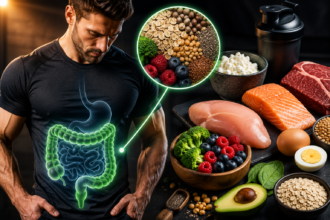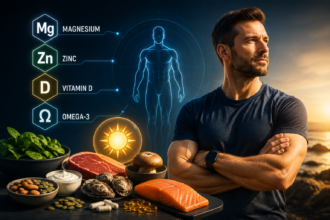

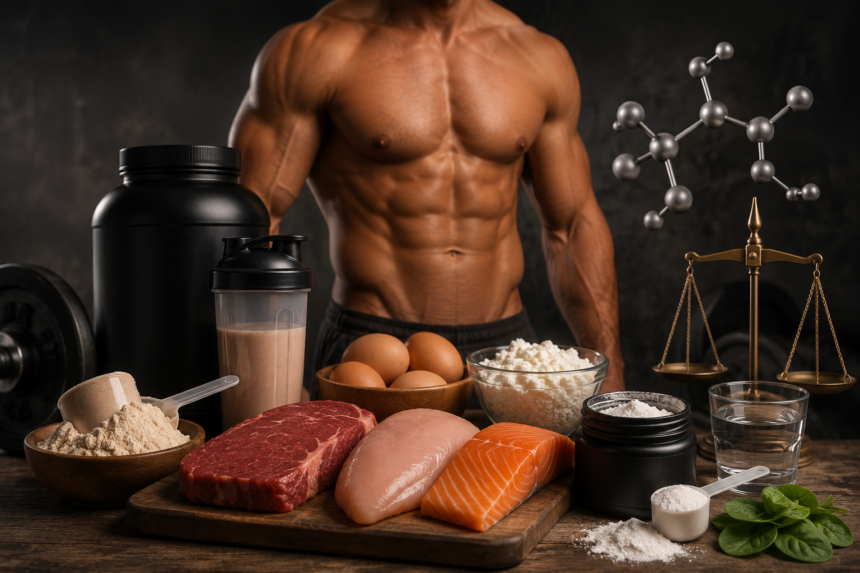
If you’ve spent any time in the Nutrition section of this site, you’ve probably noticed the information is solid but scattered across separate posts: how much protein to eat, whether creatine or protein powder deserves your money first, which foods are linked to testosterone, and a handful of notes on snacks. Each piece is correct on its own, but a reader trying to actually organize his diet needs to see how these pieces fit together, with the numbers explained once, in one place, and connected to the deeper guides already living in our nutrition archive.
This article does that. It’s organized from most important to most secondary: how much protein you need, where to get it, when to spread it out, what role creatine actually plays, what real evidence supports the diet-testosterone connection, and which everyday mistakes with snacks and labels quietly wreck an otherwise good diet. Studies and figures are cited as they appear in the available literature, limitations included, and cross-linked to related reading so you can go deeper on whichever piece matters most to you.
1. The principle that organizes everything: your daily protein budget
Before talking about specific foods, it’s worth fixing one number that will drive almost every decision that follows: how much protein you actually need per day.
Sports nutrition research is fairly consistent on a range of 1.6 to 2.2 grams of protein per kilogram of body weight for men who train for strength and want to build or maintain muscle mass. In practice, that breaks down to:
- Maintenance phase (holding onto what you already have): 1.6–1.8 g/kg
- Muscle-gain phase (moderate caloric surplus): 2.0–2.2 g/kg
- Cutting phase (caloric deficit): 2.2–3.0 g/kg — precisely because an aggressive caloric deficit is when it’s easiest to lose muscle, and high protein is the single best tool to prevent that.
For an 80 kg (176 lb) man, that means somewhere between 130 and 240 grams of protein a day depending on the goal. This number — not the supplement brand you buy, not the exact hour you train — is the variable that will most determine your results. Eating below your range limits muscle growth no matter how hard you train; eating well above the upper limit doesn’t add meaningful extra benefit in healthy people. If you’re still dialing in training volume alongside diet, our strength training guides cover how the two interact.
One important clarification: for healthy men without pre-existing kidney disease, clinical evidence does not support the idea that high protein intake (up to 3 g/kg) damages the kidneys. That risk applies to people who already have compromised kidney function, not to the general population.
2. The best protein sources, organized by context
Instead of repeating a generic 1-to-15 ranking with no real criteria, it makes more sense to group protein sources by the problem they solve. Every option below is a complete protein, or easy to combine into one. For the full ranked breakdown with more options and sourcing notes, see The 15 Best Protein Sources for Muscle Gain, Ranked by Science.
For daily bulk and low cost
- Chicken and turkey breast: roughly 30 g of protein per 100 g, with very little fat. It’s the most practical base for batch-cooked meals.
- Canned tuna in water: 25–29 g of protein per 100 g can, under 120 calories. No cooking required, and one of the most cost-efficient foods per gram of protein.
- Whole eggs: considered the “reference” protein because nearly 100% of their content is usable by the body. The yolk also supplies fat-soluble vitamins and cholesterol, a precursor to steroid hormones — more on that in the testosterone section below.
For before bed (slow-release protein)
- Cottage cheese and Greek yogurt: both are rich in casein, a protein that releases amino acids steadily over several hours. Eating them before sleep helps slow muscle breakdown during the overnight fast.
- Casein protein powder: serves the same function as yogurt or cottage cheese, just more concentrated, if you prefer a shake.
For post-workout
- Whey protein: digests quickly and has the highest leucine content — the amino acid that most triggers muscle protein synthesis — of any known source. It’s useful because it’s fast, not because there’s a “magic window” (see Section 3). If you’re wondering whether that tub in your cupboard is still good, we cover shelf life and storage in Can Protein Powder Go Bad?
- Salmon and other fatty fish: provide quality protein alongside omega-3s, which evidence links to a better anabolic response to training and less post-exercise inflammation.
Plant-based options (for vegans, vegetarians, or just variety)
- Edamame and tempeh: among the few plant sources that provide all nine essential amino acids in favorable proportions.
- Lentils and legumes: not a complete protein on their own (they lack methionine), but combined with rice or whole grains they become one, at a much lower cost than meat.
- Pumpkin seeds: besides protein, they supply zinc and magnesium, two minerals that reappear in the testosterone section further down.
The practical takeaway: there’s no single “best” protein source. There’s the right source for the time of day and the budget you have. A realistic plan combines 2–3 daily animal sources, one slow-release source for the night, and plant variety for fiber and micronutrients.
3. The “anabolic window” myth and how to actually distribute your meals
One of the most persistent myths — and one of the most profitable for the supplement industry — is that there’s a 30-to-60-minute window after training in which you “must” eat protein or you’ll lose most of the muscle-growth stimulus.
A 2017 meta-analysis published in the Journal of the International Society of Sports Nutrition, which reviewed 49 studies on the topic, reached a much more boring but far more useful conclusion: what determines your results is total daily protein, not the exact minute you consume it. Eating enough protein at some point within the hours around your workout is sufficient; there’s no evidence that 30 minutes post-workout produces better results than eating three hours later.
That doesn’t mean meal distribution is irrelevant. On the contrary: the evidence does support spreading protein across 4 to 6 servings of 20 to 40 grams throughout the day, rather than concentrating it into one or two big meals. This pattern maximizes how many times a day you trigger muscle protein synthesis.
Here’s a sample split for a 180 g daily target:
| Meal | Approximate Protein | Example |
|---|---|---|
| Breakfast | 35–40 g | 4 eggs + 2 slices of whole-grain toast |
| Mid-morning | 25–30 g | Greek yogurt with fruit and granola |
| Lunch | 40–45 g | Chicken or turkey breast with rice and vegetables |
| Pre-workout | 20–25 g | Protein shake with banana |
| Dinner | 40–45 g | Beef, fish, or legumes with sweet potato |
The pre-workout meal deserves its own mention: eating a small amount of protein and carbohydrates 60 to 90 minutes before training does help preserve muscle tissue during the session and maintain performance, thanks to available glycogen and amino acids. For a deeper dive on meal timing around training days, check our Complete Guide to Protein Timing for Muscle Growth.
4. Creatine vs. protein: they don’t compete, they complement each other
It’s common for a man who’s starting to train seriously to ask “creatine or protein?” as if he has to pick a side. The question comes from a misunderstanding: these are two tools that act on completely different biological processes.
Protein supplies amino acids — the raw building material — that the body uses to repair and build new muscle tissue after training. Without enough protein, that process simply can’t happen, no matter how hard you train.
Creatine doesn’t build muscle directly. It’s a molecule stored in muscle tissue as phosphocreatine, functioning as a fast energy reserve for explosive efforts under 10 seconds — lifting heavy, sprinting, jumping. Supplementing with creatine monohydrate saturates those reserves beyond what a normal diet allows, which in practice translates to:
- Completing 1 to 3 extra reps per set
- Recovering faster between heavy sets
- Accumulating more total training volume over time, which is precisely the main driver of muscle growth
A 2025 meta-analysis in the Journal of the International Society of Sports Nutrition, which reviewed 22 controlled studies, found that creatine supplementation increased lean mass by an average of 1.37 kg more than placebo after 4 to 12 weeks of use.
Which should you prioritize based on your goal?
| Goal | Priority |
|---|---|
| Maximum muscle mass gain | Both — they’re synergistic, not redundant |
| Fat loss while preserving muscle | Protein first (2.2–3.0 g/kg), creatine as secondary support |
| Gym performance and strength | Creatine first |
| Long-term general health | Protein has broader applications; both are safe |
| Vegetarian or vegan diet | Creatine first — your dietary creatine intake is essentially zero |
If you can only afford one supplement right now: buy protein powder if you rarely hit your daily target with real food; buy creatine if you already meet your protein goals through food but want more gym performance. For the full head-to-head breakdown, see Creatine vs Protein: Which Is Better for Men?
A few clarifications worth repeating, since the myths persist:
- You don’t need a loading phase. Taking 5 g daily consistently saturates your muscle stores in 3–4 weeks, with the same end result as a loading protocol of 20 g daily for a week.
- The initial weight gain with creatine is intracellular water, held inside the muscle, not fat or subcutaneous retention. It’s not a negative aesthetic effect — it actually makes muscle look fuller.
- The long-term renal and hepatic safety of creatine monohydrate (up to 5 years of continuous use) is well documented in healthy people; the myth that it “damages the kidneys” has no serious clinical backing.
5. Foods and habits that support healthy testosterone
Testosterone doesn’t “spike” from eating one specific food, but there are dietary patterns with reasonable scientific backing that support healthy hormone production over time. Before the list, it’s worth understanding what lowers it in the first place: diets high in ultra-processed foods and seed oils, chronic stress with elevated cortisol, poor sleep, excess body fat, a sedentary lifestyle, and exposure to endocrine disruptors in plastics.
With that in mind, here are the food groups with the most evidence behind them:
- Whole eggs: the yolk provides cholesterol, a direct precursor to testosterone, along with zinc and vitamin D.
- Oysters and shellfish: the most concentrated source of zinc there is; zinc inhibits aromatase, the enzyme that converts testosterone into estrogen.
- Beef, preferably grass-fed: provides fats needed for hormone synthesis, plus zinc, B12, and creatine.
- Extra virgin olive oil: its monounsaturated fats and polyphenols support the function of Leydig cells, which produce testosterone in the testes.
- Fatty fish (salmon, sardines, mackerel): combines omega-3s, vitamin D, and selenium.
- Leafy greens (spinach, kale, chard): rich in magnesium, a mineral most Western men are deficient in, and one correlated with free testosterone levels.
- Cruciferous vegetables (broccoli, cauliflower, Brussels sprouts): help the liver clear excess circulating estrogen.
- Brazil nuts: 2–3 a day cover your daily selenium requirement. Important: don’t exceed 4 per day, since excess selenium is toxic.
- Avocado: monounsaturated fats plus boron, a trace element linked to free testosterone.
- Garlic and ginger: both have preliminary evidence of lowering cortisol or improving the testosterone-to-cortisol ratio.
- Dark chocolate (85% cacao or higher): in moderate amounts (a 40 g portion), provides zinc, magnesium, and flavonoids.
What works against you
- Excess alcohol (3 or more drinks daily is associated with notable reductions in testosterone)
- Habitual ultra-processed food and fast food, which raise cortisol
- Refined seed oils (soybean, canola, sunflower) in excess, due to their inflammatory profile
- Very high amounts of soy and flaxseed, due to their phytoestrogen content — though moderate, occasional consumption isn’t a real problem for most men
One important note: these dietary changes usually take 4 to 12 weeks to show up measurably. If you have clinically low testosterone (below 300 ng/dL confirmed by bloodwork), diet helps but doesn’t replace a medical consultation. For the complete, ranked food-by-food list, see 15 Best Testosterone Booster Foods for Men.
6. Snacks, labels, and the silent mistakes that ruin a good diet
You can have your protein target and main meals perfectly dialed in and still sabotage your progress with the decisions you make between meals. Two practical ideas that tend to be missing from nutrition guides:
First, not everything marketed as “healthy” is healthy in the context that matters. Whole-grain-style crackers, “protein” bars, or snacks labeled low-fat can still be high in sodium, added sugars, or refined oils — we broke down exactly this for one popular cracker brand in Are Triscuits Healthy? The habit that makes the difference is checking three things on the label before deciding: grams of added sugar, type of fat (avoid trans fats and limit excess saturated fat), and the actual serving size those numbers are based on, which is often smaller than people assume.
Second, a “good” snack is one that solves a real problem: satiety and protein between meals, not just empty calories. Some simple combinations that do that job:
- Cottage cheese or Greek yogurt with fruit
- A handful of nuts with a piece of fruit
- Hard-boiled eggs prepared in advance
- Hummus with raw vegetables
- Canned tuna with real whole-grain crackers (check the label, not just the package name)
For more combinations built around this same satiety-and-protein logic, see Healthy Snacks for Weight Loss: Simple Choices That Actually Work.
The general rule: if a snack doesn’t provide protein or fiber, it’s probably just a blood sugar spike followed by hunger again a couple of hours later. That’s not a moral judgment about the food — it’s simply how satiety works.
7. Hydration and micronutrients most men underrate
Protein, creatine, and testosterone-supportive foods get most of the attention, but two quieter factors shape how well all of the above actually works.
Hydration affects strength output more than most men realize. A drop of just 2% in body water can measurably reduce strength and endurance performance. As a rough baseline, aim for 35–40 ml of water per kilogram of body weight daily, and more on training days or in hot climates. Creatine supplementation slightly increases your water needs, since it pulls water into muscle cells — another reason to keep a water bottle nearby once you start using it.
Vitamin D deserves a mention on its own, separate from the testosterone list above, because deficiency is extremely common — especially for men who train indoors or live in northern latitudes with limited sun exposure. Low vitamin D is associated with lower testosterone, reduced strength gains, and weaker bone density. A blood test is the only reliable way to know where you stand; supplementing blindly at high doses isn’t advisable without one.
Fiber is the other quiet variable. Men focused on hitting a protein number often let fiber slide, which shows up later as poor digestion and blood sugar swings that make hunger harder to manage. Vegetables, legumes, and whole grains covered in the protein sources section above do double duty here.
8. Common mistakes that stall progress even on a “good” diet
A few patterns show up repeatedly in men who are eating “well” on paper but not seeing results:
- Underestimating portions. Eyeballing a chicken breast or a scoop of rice consistently underestimates real intake by 20–30%. Weighing food for a couple of weeks, even roughly, resets your sense of scale.
- Treating liquid calories as free. Juices, flavored coffees, and alcohol add up fast and rarely contribute protein or satiety.
- Chasing supplements before fixing the basics. No supplement compensates for a protein target that’s consistently missed or for five hours of sleep a night. The order matters: food and sleep first, supplements second.
- All-or-nothing thinking after one bad meal. One high-sodium, low-protein day doesn’t undo a week of consistent eating; the damage usually comes from treating it as a reason to abandon the plan entirely.
- Ignoring sleep’s effect on appetite and hormones. Poor sleep raises cortisol and ghrelin (a hunger hormone), which makes sticking to any plan — protein target included — noticeably harder.
9. Putting it together: a realistic daily template
Bringing everything above into one place, here’s what a full day looks like for an 80 kg man in a muscle-gain phase (target: roughly 170–180 g of protein, with attention to testosterone support and smart snacking):
- Breakfast: 4 whole eggs + whole-grain toast + avocado → protein, hormone-useful cholesterol, monounsaturated fats
- Mid-morning snack: Greek yogurt with Brazil nuts (2–3) and fruit
- Lunch: chicken or turkey breast, rice or quinoa, broccoli, extra virgin olive oil
- Pre-workout (60–90 min before): banana + whey shake
- Post-workout: the same shake counts — no need to repeat within a strict “window”
- Dinner: salmon or lean beef, sweet potato, leafy greens
- Before bed: cottage cheese or Greek yogurt (slow-release casein)
- Creatine: 5 g daily, any time of day, consistently — timing matters far less than consistency
This isn’t a rigid prescription, it’s a reasoning template: it covers total daily protein, spreads it across meals, includes a slow source before bed, supports hormone production with the right fats and micronutrients, and leaves room for a performance supplement (creatine) without depending on it for the essentials. For workout-specific meal timing, revisit the Complete Guide to Protein Timing for Muscle Growth.
10. Frequently asked questions
Do I need protein powder if I already eat enough protein from real food? No. Protein powder is a convenience tool, not a requirement. If you already hit your daily target with food, a supplement doesn’t add meaningful extra benefit.
Can creatine and protein be taken together safely? Yes, with no known negative interaction. In fact, for most men training toward a body composition goal, using both produces better results than either alone.
Can I raise my testosterone with diet alone if my levels are clinically low? Diet is the most powerful lever you can control without a prescription, but if bloodwork confirms hypogonadism, the sensible approach is combining dietary changes with a visit to an endocrinologist, not replacing one with the other.
Is eating a lot of protein dangerous for the kidneys? In healthy men without pre-existing kidney disease, evidence doesn’t support that concern up to levels of 3 g/kg daily. The real risk applies to people whose kidney function is already compromised.
How much water should I drink if I’m also taking creatine? There’s no fixed extra number, but since creatine draws water into muscle cells, most men do well adding roughly 500 ml–1 L above their usual daily intake, especially in the first few weeks of supplementation.
This article is for informational purposes and doesn’t replace the advice of a health professional, nutritionist, or physician. If you have a pre-existing medical condition or questions about your specific situation, consult a specialist before making major changes to your diet or supplementation.
For more evidence-based guides like this one, visit the full Nutrition category on MensBuddy.
Sources
- Morton, R.W., Murphy, K.T., McKellar, S.R., et al. (2018). A systematic review, meta-analysis and meta-regression of the effect of protein supplementation on resistance training-induced gains in muscle mass and strength in healthy adults. British Journal of Sports Medicine, 52(6), 376–384. doi:10.1136/bjsports-2017-097608
- Schoenfeld, B.J., Aragon, A.A., & Krieger, J.W. (2013). The effect of protein timing on muscle strength and hypertrophy: a meta-analysis. Journal of the International Society of Sports Nutrition, 10, 53. doi:10.1186/1550-2783-10-53
- Aragon, A.A., & Schoenfeld, B.J. (2013). Nutrient timing revisited: is there a post-exercise anabolic window? Journal of the International Society of Sports Nutrition, 10, 5. doi:10.1186/1550-2783-10-5
- Antonio, J., Ellerbroek, A., Silver, T., et al. (2016). A high protein diet has no harmful effects: a one-year crossover study in resistance-trained males. Journal of Nutrition and Metabolism, 2016, 9104792. doi:10.1155/2016/9104792
- Kreider, R.B., Kalman, D.S., Antonio, J., et al. (2017). International Society of Sports Nutrition position stand: safety and efficacy of creatine supplementation in exercise, sport, and medicine. Journal of the International Society of Sports Nutrition, 14, 18. doi:10.1186/s12970-017-0173-z
- Pashayee-Khamene, F., Heidari, Z., Asbaghi, O., et al. (2024). Creatine supplementation protocols with or without training interventions on body composition: a GRADE-assessed systematic review and dose-response meta-analysis. Journal of the International Society of Sports Nutrition, 21(1). doi:10.1080/15502783.2024.2380058
- Delpino, F.M., Figueiredo, L.M., Forbes, S.C., Candow, D.G., & Santos, H.O. (2022). Influence of age, sex, and type of exercise on the efficacy of creatine supplementation on lean body mass: a systematic review and meta-analysis of randomized clinical trials. Nutrition, 103–104, 111791. doi:10.1016/j.nut.2022.111791
- Whittaker, J., & Wu, K. (2021). Low-fat diets and testosterone in men: Systematic review and meta-analysis of intervention studies. The Journal of Steroid Biochemistry and Molecular Biology, 210, 105878. doi:10.1016/j.jsbmb.2021.105878
- Pilz, S., Frisch, S., Koertke, H., et al. (2011). Effect of vitamin D supplementation on testosterone levels in men. Hormone and Metabolic Research, 43(3), 223–225. doi:10.1055/s-0030-1269854
- Cinar, V., Polat, Y., Baltaci, A.K., & Mogulkoc, R. (2011). Effects of a 4-week zinc supplementation and exhaustive exercise on serum testosterone levels in athletes. Biological Trace Element Research, 140(1), 18–23. doi:10.1007/s12011-010-8676-1
- Cheuvront, S.N., & Kenefick, R.W. (2014). Dehydration: physiology, assessment, and performance effects. Comprehensive Physiology, 4(1), 257–285. doi:10.1002/cphy.c130017