
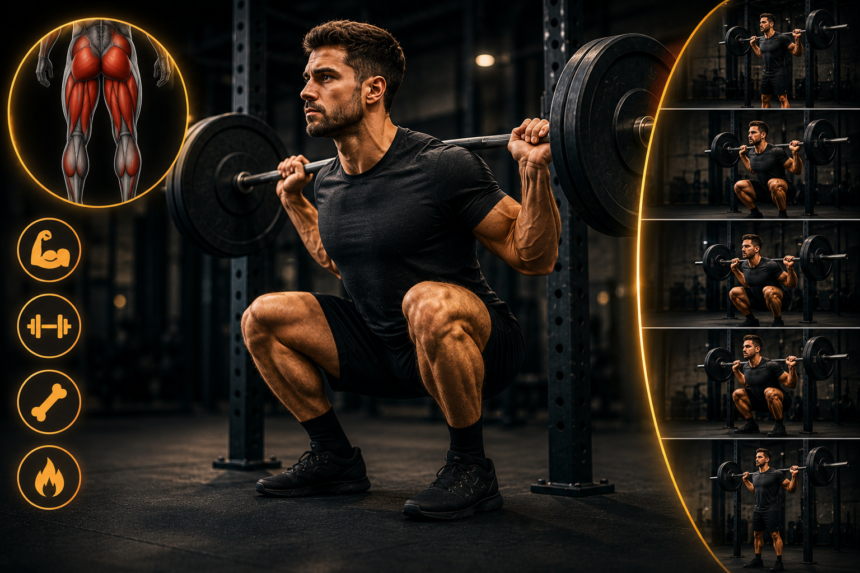
“If you want stronger, more powerful legs, the barbell back squat is one of the most effective exercises you can add to your routine. It targets your quads, hamstrings, and glutes all at once, and when done correctly it builds the kind of full-body strength that carries over into almost every other lift.”
In this complete guide, we cover exactly how to perform the barbell back squat, what muscles it works, the most common mistakes to avoid, and how to fit it into your programme for maximum results.
Whether you are just starting out or have been training for years, this movement deserves a place at the center of your leg day. Let’s get into everything you need to know.
What is the Barbell Back Squat?
The barbell back squat is a compound lower-body exercise where you rest a loaded barbell across your upper back and shoulders, then bend your knees and hips to lower your body before driving back up to standing. It is widely considered one of the most effective strength-building exercises that exists, because it recruits an enormous amount of muscle mass in a single movement.
Unlike an isolation exercise, the back squat does not just work one muscle group. It demands coordinated effort from your quads, glutes, hamstrings, core, and even your upper back to keep the bar stable. This is exactly why strength coaches so often build entire leg days around this one lift, and why it pairs so naturally with other compound movements like Barbell Rows for Upper Back on a well-rounded training split.
The exercise can be loaded from a squat rack, performed with a high-bar or low-bar position, and adjusted in depth and stance width depending on your goals and mobility. Each variation shifts the emphasis slightly, which we’ll cover further in this guide.
Muscles Worked by the Barbell Back Squat
Understanding which muscles this exercise targets helps you programme it intelligently and understand why it deserves a regular spot in your training plan.
| Muscle | Role in the Exercise | Activation Level |
|---|---|---|
| Quadriceps | Primary mover | Very High |
| Glutes (Gluteus Maximus) | Primary mover | Very High |
| Hamstrings | Secondary support | Moderate to High |
| Erector Spinae (Lower Back) | Stabilises the spine | High |
| Core (Abs & Obliques) | Stabilises the trunk | High |
| Upper Back & Traps | Supports the bar | Moderate |
The quads and glutes do the majority of the work, but the sheer amount of stabilization required from your core and lower back is part of what makes the squat such a powerful full-body builder. If your goal is serious lower-body size and strength, no isolation exercise can replace what the back squat delivers.
How to Do the Barbell Back Squat: Step-by-Step
Technique matters enormously with this exercise. Poor form does not just reduce results, it also puts real strain on your knees, hips, and lower back. Follow these steps carefully every single rep.
Setting Up the Bar
Set the barbell in a squat rack at roughly chest height. Duck under the bar and position it across your upper back, either resting on your traps just below the neck (high-bar) or slightly lower across your rear delts (low-bar). Grip the bar comfortably wider than shoulder-width, lift your chest, and squeeze your shoulder blades together to create a stable shelf for the bar. Stand up to unrack it, then take two controlled steps backward and set your feet roughly shoulder-width apart with toes turned slightly out.
The Descent
Take a deep breath, brace your core as if bracing for a punch, and begin the movement by pushing your hips back and bending your knees at the same time. Keep your chest up and your weight balanced through the middle of your feet, not just your toes. Continue lowering under control until your hip crease drops below the top of your knee, or as close to that depth as your mobility allows.
| Key Tip: Keep your knees tracking in the same direction as your toes throughout the descent. Letting them cave inward is one of the most common technique breakdowns and a major cause of knee discomfort over time. |
|---|
The Ascent
Drive through your whole foot, heels included, and push the floor away as you straighten your hips and knees to return to standing. Keep your chest up and avoid letting your hips shoot upward before your shoulders, this breaks the bar path and puts unnecessary stress on your lower back. Exhale as you complete the lift and reset your brace before starting the next rep.
Common Mistakes to Avoid
The barbell back squat is a technical lift, and there are several mistakes that show up constantly, especially among beginners. Avoiding these will make the exercise significantly safer and far more effective.
Letting the Knees Cave Inward
When the weight gets challenging, it’s common for the knees to drift inward, especially near the bottom of the rep. This shifts stress onto the inner knee and reduces power output. Actively think about “spreading the floor” with your feet and pushing your knees out in line with your toes on every rep.
Not Squatting Deep Enough
Stopping well above parallel reduces how much your glutes and hamstrings actually contribute to the lift, and it can encourage using more weight than your true strength supports. Work toward at least reaching parallel depth, using a lighter load if that’s what it takes to get there with good form.
Rounding the Lower Back
Losing the brace in your core and letting your lower back round, particularly at the bottom of a deep squat, puts significant strain on the spine. Keep your core tight throughout the entire rep, and if you notice rounding, that’s a signal to reduce the weight or work on your mobility before adding more load.
Rising Hips First
If your hips shoot upward while your shoulders stay pinned near the floor, the bar path tips forward and turns the squat into something closer to a good morning. Focus on driving your chest and hips upward together, keeping the bar traveling in as straight a vertical line as possible.
Barbell Back Squat Variations

Once you’ve built a solid foundation with the standard back squat, these variations can add new stimulus, address weak points, or accommodate mobility limitations.
Front Squat
Holding the bar across the front of your shoulders instead of your back shifts more emphasis onto the quads and demands a more upright torso. It’s a great option for lifters who want extra quad development or who find the back squat aggravates their lower back.
Box Squat
Squatting down to lightly touch a box or bench set at or just below parallel teaches you to sit back properly and removes any bounce out of the bottom position. This is especially useful for beginners still learning depth and control, or for lifters working on explosive power off the bottom.
Pause Squat
Adding a two- to three-second pause at the bottom of the rep removes momentum entirely and forces your muscles to generate force from a dead stop. This variation is brutal but highly effective for building strength out of the “hole,” the toughest part of the lift for most people.
Safety Bar Squat
Using a specialty safety squat bar, which rests further forward on the shoulders with handles instead of a straight bar, reduces strain on the shoulders and wrists and allows a more upright torso. It’s a useful substitution for lifters dealing with shoulder mobility issues who still want the benefits of a heavy squat pattern.
How to Programme the Barbell Back Squat
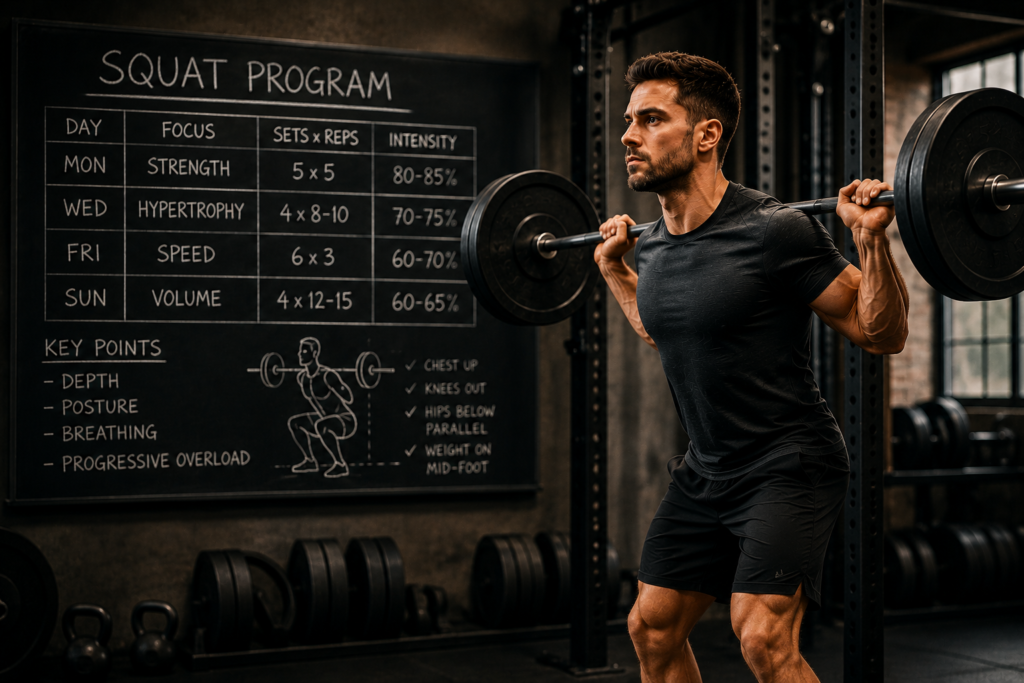
The back squat is best used as the primary, heaviest movement of your leg day, performed early in the session while you’re fresh. Here’s how to include it effectively depending on your training goal.
| Training Goal | Sets | Rep Range |
|---|---|---|
| Muscle Building | 3 – 4 | 8 – 12 reps |
| Strength | 4 – 5 | 3 – 6 reps |
| Beginner | 3 | 8 – 10 reps |
| Power / Athletic | 4 – 6 | 2 – 5 reps |
Perform the back squat first on leg day, before any isolation work like lunges or leg extensions, since it demands the most from your nervous system and stabilizing muscles. For most men, squatting once or twice a week is enough to drive consistent progress, provided the weight or reps increase gradually over time, the core principle of progressive overload.
If your lower-body split also includes hip-dominant work, pairing the back squat with hamstring-focused accessories rounds out the leg day nicely, and a well-built routine like a Push Pull Legs Workout Plan for Beginners gives the squat a natural home within a broader weekly structure. Managing your recovery between heavy sets also matters more than most lifters expect, if you’re unsure how long to rest, How Long Should I Rest Between Sets to Crush My Workout Goals breaks that down directly.
| Want More Strength Training Guides? Visit MensBuddy.com for free expert guides on training, nutrition, and men’s health. |
|---|
Frequently Asked Questions
How heavy should I start with the barbell back squat?
Start with just the empty bar, or a very light weight, until your depth and bar path look consistent on video. Most beginners can add weight gradually from there, but form should never be sacrificed for load, especially in the first few weeks of learning the pattern.
How many reps and sets should I do?
For general muscle building, 3 to 4 sets of 8 to 12 reps works very well. If your priority is raw strength, lower reps in the 3 to 6 range with heavier loads and longer rest periods are more effective. Beginners should stick to moderate reps around 8 to 10 while form is still developing.
Is the barbell back squat bad for your knees?
When performed with good form and appropriate depth, the squat is not inherently bad for healthy knees, research generally supports that squatting to full depth is safe and even protective for knee health over time. People with existing knee or hip injuries should consult a physiotherapist before adding heavy loaded squats to their routine.
Should I do high-bar or low-bar squats?
High-bar squats keep the torso more upright and place more emphasis on the quads, while low-bar squats shift more work to the hips and hamstrings and often allow slightly heavier loads. Neither is objectively better, the right choice depends on your goals, mobility, and torso-to-leg proportions.
Can I replace the back squat with leg press?
Not entirely. The leg press can be a useful accessory, but it removes the balance, core stabilization, and full-body coordination demands of a loaded barbell squat. For complete lower-body development, the back squat and its variations deserve a primary place in your programme.
How often should I squat per week?
Once or twice per week is the sweet spot for most men, allowing enough recovery between sessions while still providing consistent practice with the movement pattern. Lifters focused heavily on strength sometimes squat more frequently, but that requires careful management of overall training volume and recovery.